The best cabin for Alaska cruise travel, for most first-timers, is a balcony cabin midship on a middle deck, on the side of the ship that faces the coast if you’re sailing one way. A balcony earns its keep in Alaska more than on almost any other itinerary: long days of scenic cruising, glaciers, whales and light until nearly midnight in June. But it isn’t essential. You’ll spend the best hours on the open decks anyway, and an inside cabin, which is darker for sleeping and far cheaper, is the smartest saving on the ship.
This guide is for travelers choosing a cabin type, a side and a deck for an Alaska cruise, with the math on whether the balcony premium is worth it. The caveat: prices, cabin sizes and perks vary by line and ship, so use the principles here and check your ship’s deck plan before you book. Last updated October 11, 2026. Every price, fee and schedule below is dated, and the sources are listed at the end.
Alaska cruise cabins at a glance
Cabin sizes below use Princess as an example, from its published stateroom pages as of September 2026. Other lines are similar in shape but not identical.
| Cabin type | Typical size (Princess) | Best for | Verdict for Alaska |
|---|---|---|---|
| Inside | About 136-162 sq ft | Budgets, light sleepers, people who live on deck | The best value |
| Oceanview | About 145-212 sq ft | Natural light without the balcony price | A modest step up |
| Balcony | About 214-222 sq ft including the balcony (Royal-class ships) | Scenic cruising days, privacy, midnight light | The best overall choice |
| Mini-suite | About 323 sq ft including a 41 sq ft balcony (Royal-class ships) | Longer cruises, couples who want space | The best upgrade |
| Suite | Larger, with perks that vary by line | Travelers who value lounges, priority and space | Worth it only for the perks you’ll use |
Verdict: if the balcony premium is modest for your sailing, take the balcony. If it would push the trip over budget or cost you a great excursion, book an inside cabin and spend the difference ashore. Nobody remembers their cabin from an Alaska cruise; they remember the whale.
What’s changed for 2027
- Gratuities rose in 2026, and they’re higher in suites. Princess charges $18 per person per day in standard staterooms and $20 in suites; Holland America $18 and $20; Royal Caribbean $18.50 and $21; Celebrity $19.50 in inside, oceanview and veranda cabins and up to $24.50 in The Retreat; Norwegian’s service charge is $20 for most cabins and $25 for suites and The Haven. On a 7-night cruise, a suite’s higher rate adds $14 to $35 per person.
- More sailings, more choice. Princess alone runs 187 Alaska departures in 2027, and new itineraries such as Holland America’s 8-day Vancouver round trip add options for picking a ship with the cabin type you want.
- Fare gaps between cabin types still vary widely. One promotional source reported 2026 fares from about $499 per person for a 7-night inside cabin in the shoulder season to about $2,500 per person for a balcony in peak July, a spread that shows how much the date matters as well as the cabin.
Every Alaska cruise cabin type, ranked
Ranked for a typical first-time Alaska cruiser, weighing what each cabin adds to this particular trip against what it costs.
1. Balcony cabin
A balcony (called a veranda on some lines) gives you a private outdoor space with two chairs and a small table, and a sliding glass door that fills the cabin with light. In Alaska that matters more than in the Caribbean, where you’re ashore or at the pool most of the day. Here, the scenery is the entertainment: long stretches of the Inside Passage, a full day of scenic cruising in Glacier Bay or Hubbard Glacier, humpbacks surfacing off the side, and evening light that lasts past 10 p.m. in June.
The balcony’s best trick is the private moment: coffee at 6 a.m. as the ship slides through a fjord, or a quiet hour at 10 p.m. when the decks have emptied. Its limit is that it faces one direction. At a glacier face, the view from your balcony depends on how the ship is turned, and the open decks will still be better for the main event. Our page asking is a balcony worth it on an Alaska cruise runs the numbers for different budgets.
2. Inside cabin
An inside cabin has no window. It’s the cheapest way onto the ship, and in Alaska it has a hidden advantage: darkness. Around the June solstice, the sun sets in Juneau after 10 p.m. and civil twilight lasts until almost 11:30 p.m.; farther north, Anchorage has civil twilight all night. Light sleepers often sleep better in an inside cabin than in any cabin with a window.
The honest downside is that you’ll need to leave the cabin to see anything, which is fine for people who treat the cabin as a place to sleep and change. The best Alaska views come from the open decks, the forward lounges and the promenade anyway. For more on making it work, see our guide to an inside cabin on an Alaska cruise.
3. Oceanview cabin
An oceanview cabin has a window or porthole that doesn’t open. It’s the compromise: natural light, a sense of where you are, and a glimpse of the scenery without paying for a balcony. On some ships the cheapest oceanview cabins are on low decks with small portholes; the better ones have large picture windows. Check the deck plan and the cabin description, because “oceanview” covers a wide range. Our guide to the oceanview cabin on an Alaska cruise explains which ones are worth the premium over inside.
4. Mini-suite
A mini-suite is a larger balcony cabin with a sitting area, sometimes a bathtub, and a slightly bigger balcony. On Princess’s Royal-class ships, a Mini-Suite is about 323 square feet including a balcony of about 41 square feet, against about 214 to 222 square feet for a standard balcony cabin. On a 7-night cruise the extra space is pleasant; on a 10- to 14-day cruise, it starts to feel necessary for two people. It’s the upgrade that most often feels worth the money.
5. Full suite
Suites add space and, more importantly, perks: priority boarding and disembarkation, private lounges or restaurants on some lines, concierge service and larger balconies. The value depends entirely on the line and on whether you’ll use the perks. A suite with a private lounge and restaurant can transform a crowded ship; a suite that’s just a bigger room is harder to justify. Suites also pay higher daily gratuities on most lines. Our Alaska cruise suite guide compares what each line includes.
6. Obstructed-view cabins
Oceanview and balcony cabins with views partly blocked by lifeboats or structures sell for less. On Princess’s Royal-class ships, for example, an obstructed-view Deluxe Balcony is listed at about 233 square feet with a 41-square-foot balcony. For Alaska, an obstructed balcony is often a good deal: you still get light and fresh air, and on glacier days you’ll be on deck anyway. An obstructed oceanview, where the window looks at a lifeboat, is harder to love.
7. Solo cabins
Solo travelers usually pay a single supplement on a standard cabin, but some ships have cabins designed for one. Norwegian, for example, sells Studios on its ships, and its service charge applies to them at the standard rate. If you’re sailing alone, compare a solo cabin with a standard inside cabin at the single rate; sometimes the solo cabin wins on price, sometimes the standard cabin wins on space.
Is a balcony worth it? The math
The balcony premium is the difference in fare between an inside or oceanview cabin and a balcony cabin on the same sailing. It varies from a few hundred dollars per person to well over a thousand, depending on the ship, the date and demand. Here’s a simple way to judge it.
| Balcony premium per person (7 nights) | Per person per night | For two people | Our take |
|---|---|---|---|
| $300 | About $43 | $600 | Take the balcony |
| $700 | $100 | $1,400 | Worth it if the budget allows |
| $1,200 | About $171 | $2,400 | Only if you’ll use it a lot |
| $2,000 | About $286 | $4,000 | Spend it on excursions instead |
Then set that against what the balcony gives you on your itinerary. A 7-day Alaska cruise usually has one scenic cruising day (a full day in Glacier Bay runs 9 to 10 hours), one or two sea days or partial sea days through the Inside Passage, and three or four port days when you’ll be ashore for most of the daylight. If you’ll spend two or three hours a day on the balcony on the scenic and sea days, a $700 premium works out to roughly $15 to $25 per hour of balcony use for two people. That’s the question to ask: would you pay that for a private, warm-ish seat with a view?
Weather affects the answer. Summer in Southeast Alaska is cool: Juneau’s July average high is 64°F and its average low about 50°F, and rain is common, especially in late summer. You’ll use a balcony in a jacket more than in a swimsuit. Some people love that; others find they sit out less than they imagined.
Verdict: in Alaska, a balcony is worth a moderate premium, and it’s the one itinerary where we’d stretch the budget for one. But if the choice is a balcony or a helicopter glacier landing, take the helicopter and book an inside cabin.
Balcony or open deck: where to watch what
Even with a balcony, you’ll split your viewing between the cabin and the public decks. Here’s where each kind of moment is best seen.
| Moment | Best spot | Why |
|---|---|---|
| Early-morning scenery in the Inside Passage | Your balcony | Quiet, warm coffee, no crowd |
| The approach up a fjord | Balcony or a forward lounge | Hours of slowly changing scenery |
| The hour at the glacier face | An open deck at the bow or high up | You can move as the ship turns, and hear the ice |
| Whale sightings | Wherever you are, with binoculars | Whales surface on either side without warning |
| Arriving in port | The open deck on the dock side | Towns come into view ahead and to one side |
| Late-evening light in June | Your balcony | The decks empty and the light lasts past 10 p.m. |
| Rain or cold wind | An indoor lounge with big windows | Staying dry beats a soggy balcony |
The pattern is clear: a balcony wins the quiet, private and long-duration moments, while the open decks win the big, fast-changing ones. That’s why a balcony is a luxury rather than a necessity in Alaska.
Which side of the ship is best?
For one-way cruises, the side matters. For round trips, it mostly doesn’t.
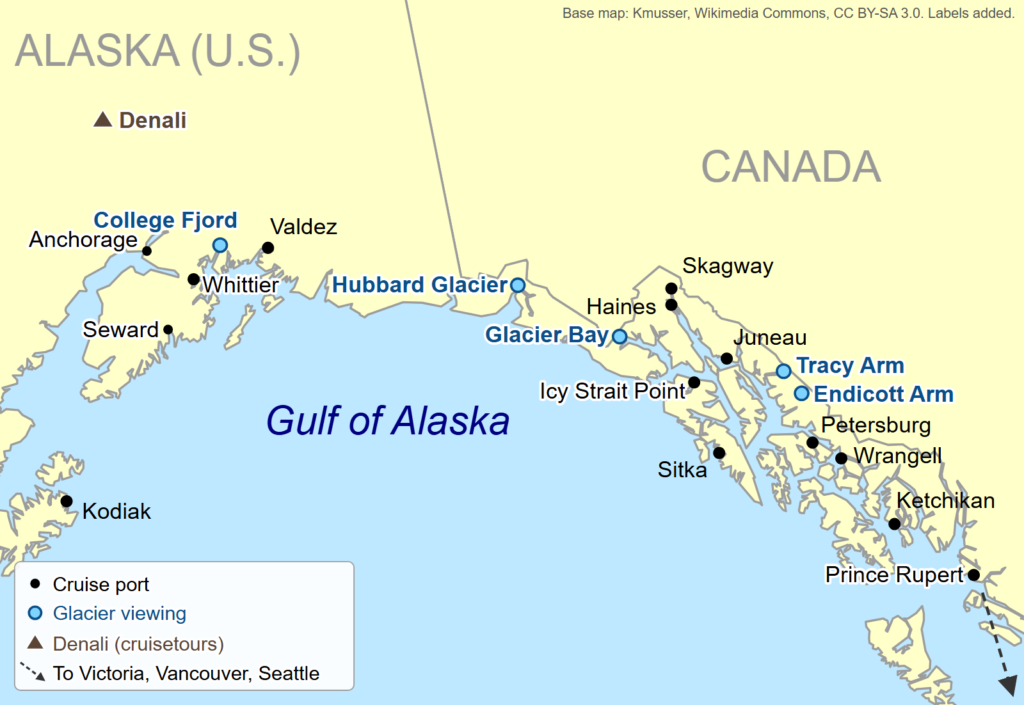
- Northbound one-way (Vancouver to Whittier or Seward): book the starboard (right) side. As the ship sails north up the Inside Passage and then west across the Gulf of Alaska, the mainland coast and most of the scenery are generally on the starboard side.
- Southbound one-way (Whittier or Seward to Vancouver): book the port (left) side, for the same reason in reverse.
- Round trips from Seattle or Vancouver: either side works. You’ll see one coast going north and the other coming back, and in the narrow channels of the Inside Passage there’s land on both sides.
- Glacier days: ships often turn at the glacier face so both sides get a view, but the best position is usually an open deck at the bow or high on the ship.
If the side costs extra or isn’t available, don’t worry about it. The difference is real but modest. Our page on which side of the ship for an Alaska cruise explains it route by route, with the exceptions.
Best cabin location for Alaska cruise travel: deck and position
Where your cabin sits on the ship affects motion, noise and convenience more than its view does. For the full breakdown, see our guide to the best deck on an Alaska cruise.
For motion: low and midship
A ship moves least near its middle and near the waterline, so a cabin midship on a lower or middle deck feels the least roll and pitch. That matters on Alaska itineraries with open-water stretches: Queen Charlotte Sound, Hecate Strait and Dixon Entrance between Vancouver Island and Ketchikan, and on one-way cruises the open Gulf of Alaska. Forward cabins feel the most pitching in a head sea, and high cabins feel more sway. If you’re prone to seasickness, low and midship is the rule.
For quiet: check what’s above and below
Look at the deck plan for the decks above and below your cabin. Cabins under the pool deck or the buffet can hear chairs scraping early in the morning; cabins above or below the theater, nightclub or galley can hear late-night noise. Cabins next to elevators and stairwells get foot traffic, though they’re convenient for travelers with limited mobility. A cabin sandwiched between two other cabin decks is the quietest.
Aft cabins
Cabins at the stern (aft) have a cult following: aft-facing balconies look straight back over the ship’s wake, often with a wider view of both shores as the ship leaves a port or a fjord. The trade-offs are more vibration from the engines and propellers on some ships, a longer walk to the forward lounges, and occasional soot or wind on the balcony. For Alaska, an aft-facing balcony is one of the best cabins for scenery. Our guide to the aft cabin on an Alaska cruise covers the pros and cons in detail.
Forward cabins
Forward cabins are close to the forward observation lounges that many ships use for scenic cruising, which is handy on glacier days. They also feel the most motion in rough water, and some forward balconies are windy. They’re a good choice for strong sailors on Inside Passage round trips, less so for one-way cruises crossing the Gulf.
Cabin features that matter in Alaska
Beyond type and location, a few details make a real difference on this itinerary.
- Blackout curtains. With sunrise before 4 a.m. in Juneau in late June, curtains that seal the edges matter. If yours leak light, a sleep mask is the fix.
- Closet and hook space. Alaska packing means bulky layers and wet rain jackets. Look for cabins with good closet space, and pack a few magnetic hooks for the metal walls.
- Temperature control. Cabins can feel warm when the heating is on and the sun is up for 18 hours. Check you can adjust the air, and don’t prop the balcony door open, which on many ships shuts the system off.
- Bed configuration. Most cabins have two twin beds that convert to a queen. If you’re sharing with a friend, confirm the beds can stay separate.
- Outlets. Cabins usually have few outlets, and some lines prohibit power strips. A multi-port USB charger solves most of it.
- Balcony size and furniture. Balconies range from a narrow ledge with two upright chairs to deep terraces with loungers. The deck plan and cabin photos show which you’re getting.
How much time will you spend in your cabin?
It helps to picture a real week before paying for a view. On a typical 7-day Alaska cruise, most of your waking hours happen somewhere other than the cabin.
| Day type (7-day cruise) | How many | Waking hours in the cabin, roughly |
|---|---|---|
| Port days, mostly ashore | 3 or 4 | 1 to 2 hours each, mostly getting ready |
| Scenic cruising day | 1 | 2 to 4 hours if you have a balcony; less without |
| Sea days | 1 or 2 | 2 to 3 hours each, reading or resting |
| Embarkation and disembarkation | 2 half days | Very little |
Those are estimates, not rules, but they make the point: the balcony pays off mainly on the scenic and sea days, and those are exactly the days when you’ll also want to be on deck. Couples who like to read, rest and watch from the cabin will use a balcony far more than families who are out from breakfast to the evening show.
Does deck height change the view?
It does, in two different ways. Lower decks put you closer to the water, which makes ice, whales and passing boats feel bigger and more immediate, and lower cabins move less. Higher decks give a broader view over the landscape, catch more of the mountains above a fjord, and look down on the water, which helps when you’re scanning for spouts. They’re also windier and feel more sway in rough water.
For a balcony in Alaska, a middle deck is the sweet spot: high enough for a wide view, low enough to feel close to the scenery, and central for motion. On ships with a wraparound promenade deck close to the water, you can get the low view for free, whatever cabin you book.
Your cabin on glacier day
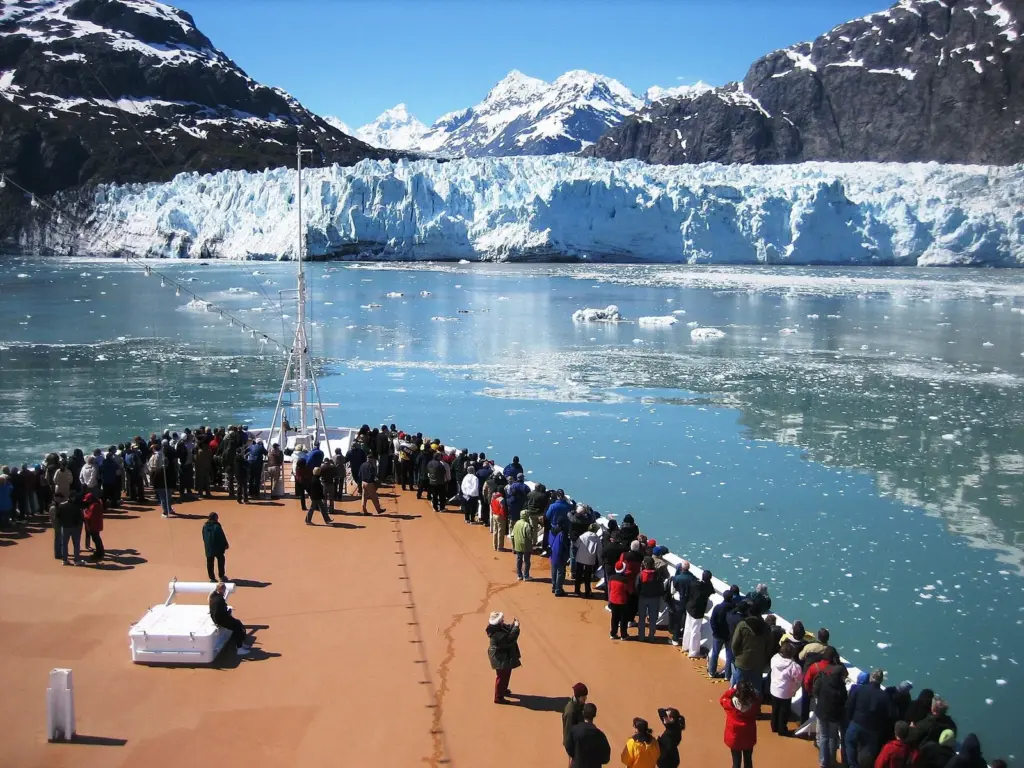
Glacier day is when cabin choice matters most, and also when it matters least. It matters because a balcony lets you watch the approach through a fjord in comfort, retreating inside when you get cold. It matters least because the moment at the glacier face is best seen from the open decks, where you can move with the view and hear the ice.
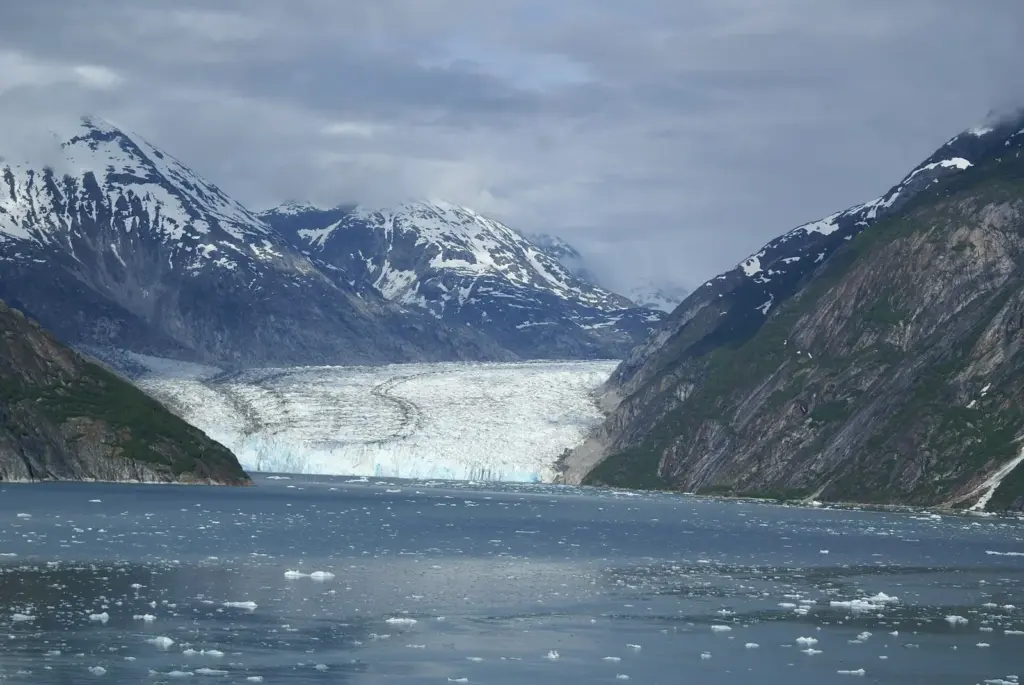
Plan the day like this whatever your cabin: breakfast early, then the balcony or a forward lounge for the approach, then an open deck for the hour at the ice, then back to the cabin or a lounge to warm up for the return. If your cabin has no view, you haven’t missed the glacier; you’ve just missed the private seat.
The best cabin for Alaska cruise itineraries, compared
| Itinerary | Best cabin | Why |
|---|---|---|
| 7-day round trip from Seattle | Balcony, any side; inside if on a budget | One glacier day, Victoria in the evening, both coasts on the way up and back |
| 7-day round trip from Vancouver | Balcony, any side | More time in the Inside Passage’s narrow channels |
| One-way northbound, Vancouver to Whittier or Seward | Starboard balcony, midship | Coast on the right; the Gulf of Alaska crossing favors midship |
| One-way southbound | Port-side balcony, midship | Coast on the left |
| Itinerary with Glacier Bay | Balcony | A full day of scenic cruising makes the balcony pay |
| 10 to 14 days | Mini-suite or larger balcony | Space matters more on a longer cruise |
| Small expedition ship | Whatever is available | Cabins are fewer and simpler; the ship is the view |
The real trade-off: cabin or excursion?
For many travelers, the balcony premium competes directly with the excursion budget. Put the numbers side by side and the choice gets clearer. Say the balcony costs $700 more per person than an inside cabin on your sailing, or $1,400 for two. In 2026, Temsco’s Mendenhall Glacier helicopter and dog-sledding tour in Juneau cost $699 per person, and Taquan Air listed its Misty Fjords floatplane flight from Ketchikan from $329 per person. The balcony premium for two would cover two seats on the dog-sledding tour, or the floatplane flight for two with change left over.
Which would you remember longer? For most people, the answer is the helicopter landing on a glacier or the floatplane over the fjords. That’s why our advice is to settle the excursion plan first and choose the cabin with what’s left. If the budget covers both, book the balcony and enjoy it. If it doesn’t, the inside cabin plus the big excursion is the better trip.
Cabins for families and groups
Families have extra options, and extra traps. Many ships have connecting cabins, two cabins with an internal door, which give parents and children separate bathrooms and a little privacy. Family cabins for four or five exist on some ships but sell out early. A popular Alaska approach is to book a balcony for the parents and an inside cabin across the hall for the children: the kids get a dark room that helps them sleep through the long summer evenings, and the adults get the view.
For groups of friends or multigenerational families, midship cabins on the same deck make meeting up easy. Grandparents with limited mobility do best near the elevators. And whatever the combination, check the maximum occupancy of each cabin before booking, because many balcony cabins sleep only two.
The best cabin by traveler
- Families: look for connecting cabins, or an inside cabin plus a balcony across the hall. Children sleep better in a dark inside cabin during Alaska’s long summer evenings.
- Couples: a balcony or mini-suite is where the romance of the trip happens, especially on a clear evening in the Inside Passage.
- Travelers with limited mobility: choose an accessible cabin near the elevators, midship, and book early, because accessible cabins are limited.
- Solo travelers: compare solo cabins with standard cabins at the single rate.
- Light sleepers: an inside cabin, or bring a sleep mask for any cabin with a window.
- Photographers: a balcony, ideally aft-facing or on the coast side for a one-way, plus time on the open decks for the best angles.
- The seasick-prone: low and midship, whatever the cabin type.
Cabin notes by cruise line
Cabin categories and names differ by line, and some lines have cabins found nowhere else. A few notes for the lines that sail Alaska most, with the caveat that ships within a line differ too. For choosing the line itself, start with our line ranking.
- Princess: standard balcony cabins on its newer Royal-class ships, such as Royal and Discovery Princess, are about 214 to 222 square feet including the balcony, and Mini-Suites add a sitting area for about 323 square feet. With 187 Alaska departures in 2027, there’s usually a cabin type available if you book early.
- Holland America: uses the term “verandah” for balcony cabins and sells suites with access to a suite lounge on many ships. Its ships are mid-size, which means shorter walks to the open decks.
- Royal Caribbean: its bigger ships sail Alaska in 2027, including Anthem and Quantum of the Seas, where some interior cabins have a screen showing a live view from outside. It’s a clever compromise for families who want a dark cabin with a sense of the scenery.
- Norwegian: sells Studios for solo travelers and, at the top end, The Haven, a suite complex with its own facilities; its service charge is higher for suites and The Haven.
- Celebrity: calls balconies “verandas” and sells The Retreat for suite guests, with a higher daily gratuity. On its newest ships, some verandas are built into the cabin behind a window wall rather than standing outside it.
Whatever the line, the same principles hold: midship for motion, the coast side for one-ways, and the balcony only if the premium is reasonable.
When cabin prices are lowest
The same cabin can cost very different amounts depending on the date you sail and when you book. Shoulder-season sailings in May and September are commonly reported to be 30 to 50 percent cheaper than peak July and August sailings, which can bring a balcony into an inside-cabin budget. Early booking gives you the widest choice of cabin locations; last-minute deals, when they appear, tend to be on less desirable cabins.
- For the best location, book as early as you can, especially for midship balconies and aft-facing cabins.
- For the best price on a balcony, look at May and September sailings, and compare the balcony premium on several dates.
- For a bargain, consider an obstructed-view balcony or a guarantee cabin, if the ship and side matter less to you.
Booking tips
- Book early for the best balconies. Midship balconies on popular summer sailings sell first. Aft-facing balconies go fast too.
- Check the deck plan. Look at what’s above, below and beside the cabin, and whether lifeboats block the view.
- Consider a guarantee cabin. Booking a cabin category without a specific cabin number can be cheaper, but you give up control of location. That’s a poor trade for a one-way cruise where the side matters.
- Watch for price drops. If the fare for your cabin type drops before final payment, ask your line or agent about repricing.
- Weigh the whole cost. The cabin is only one part of the budget. For the full picture of fares, gratuities and extras, see our guide to Alaska cruise cost.
- Choose the line first. Cabin standards differ by line and ship. If you haven’t picked one yet, start with our ranking of the best cruise line for Alaska.
Accessible cabins
Every major line sells accessible cabins with wider doors, roll-in showers and more turning space, in inside, oceanview, balcony and suite categories. They’re limited in number and reserved for guests who need them, so book early and tell the line your specific needs. For Alaska, look for an accessible cabin midship near the elevators, and check whether the balcony has a ramp or a lip at the door. Also ask about tendering and port access: most big-ship calls in Alaska are docked, which helps, but some gangways are steep at low tide.
Upgrades: when they’re worth chasing
Some lines run upgrade offers or bidding programs after you book, inviting you to pay for a better cabin category closer to sailing. For Alaska, an upgrade from inside to balcony is the one most likely to be worth it, especially on an itinerary with Glacier Bay or a long scenic cruising day. An upgrade from balcony to a larger balcony cabin rarely changes the trip. If an offer comes in, set a price you’d be happy to pay per night, and let the rest go.
Cabin mistakes to avoid
- Paying a big premium for a side on a round trip. You’ll see both coasts over the week.
- Booking a guarantee cabin on a one-way cruise. You lose control of the side, the one time it matters.
- Ignoring what’s above and below. A cabin under the pool deck or over a nightclub can ruin sleep.
- Choosing forward and high when you get seasick. Low and midship is the rule.
- Assuming a balcony replaces the decks. For the glacier face, go outside.
- Spending the excursion budget on the cabin. The whale-watching trip will stay with you longer than the balcony.
A cabin checklist before you book
- Cabin type chosen, with the balcony premium worked out per night
- Side chosen for a one-way cruise (starboard northbound, port southbound)
- Deck plan checked for noise above, below and beside
- Midship and lower if anyone gets seasick
- Lifeboat obstruction checked for oceanview and balcony cabins
- Bed configuration and accessibility needs confirmed
- Gratuity rate for the category noted in the budget
Getting the most from a balcony in Alaska
If you do book a balcony, use it well. Keep a fleece and a blanket by the door, because Alaska evenings are cool and the wind off the water is colder than the air temperature suggests. Order room-service breakfast on scenic mornings and eat it outside as the ship enters a fjord. Keep binoculars on the balcony table so they’re ready when someone spots a spout. And leave the curtains open for the first light, which comes before 4:30 a.m. in June: the Inside Passage at dawn, from your own balcony, is one of the best things an Alaska cruise offers.
For more advice on life aboard, from Wi-Fi to seasickness, see our Alaska cruise tips.
Cabin terms decoded
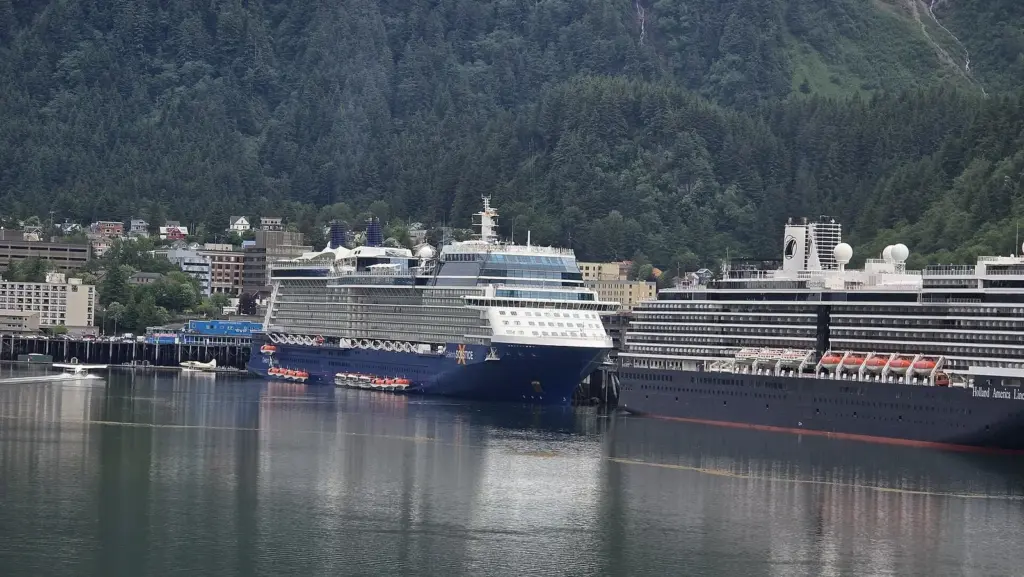
Cruise lines use their own vocabulary for cabins. Here’s what the common terms mean when you’re reading a booking page.
- Stateroom: the cruise industry’s word for a cabin. They mean the same thing.
- Veranda or verandah: a balcony. Celebrity says veranda; Holland America says verandah.
- Port and starboard: the left and right sides of the ship when you face forward.
- Forward, midship and aft: the front, middle and back of the ship. Aft-facing cabins look back over the wake.
- Obstructed view: a window or balcony partly blocked by lifeboats or other structures, sold at a discount.
- Guarantee cabin: you book a category, and the line assigns the specific cabin later. It can be cheaper, but you can’t choose the location.
- Connecting cabins: two cabins with an internal door between them, good for families.
- Category code: the letter-and-number code for a cabin grade. Two cabins that look alike can be in different categories because of their deck or location.
Best cabin for Alaska cruise travel: FAQ
Is a balcony worth it on an Alaska cruise?
Usually, yes, if the premium is moderate. Alaska has long scenic cruising days, glaciers, wildlife and very long summer evenings, all of which a balcony makes more enjoyable. But the best views at the glaciers are from the open decks, so if the balcony would cost you a major excursion, choose the excursion and an inside cabin.
Which side of the ship is best for an Alaska cruise?
On a northbound one-way cruise from Vancouver to Whittier or Seward, the starboard (right) side faces the coast for most of the trip; southbound, the port (left) side does. On round trips from Seattle or Vancouver, either side is fine, because you see both coasts over the week.
What is the best cabin location for an Alaska cruise?
Midship on a lower or middle deck is the best all-around location: it has the least motion, which matters on open-water stretches like the Gulf of Alaska, and it’s central to everything. Check the deck plan to avoid cabins under the pool deck or near late-night venues.
Is an inside cabin OK for an Alaska cruise?
Yes, and it’s the best value. You’ll watch the best scenery from the open decks anyway, and the darkness helps you sleep during Alaska’s long summer evenings, when civil twilight in Juneau lasts until 11:27 p.m. at the solstice. Spend the savings on a great excursion.
Do you need a balcony to see the glaciers?
No. On glacier days, the open decks at the bow and high on the ship give the best views, and ships commonly turn at the face so both sides see the ice. A balcony adds comfort and privacy on the approach, but everyone on the ship sees the glacier.
What is the best cabin for seasickness on an Alaska cruise?
A cabin low and midship, where the ship moves least. The Inside Passage is mostly sheltered, but open stretches such as Queen Charlotte Sound and the Gulf of Alaska can be rough. Avoid forward and very high cabins if motion bothers you.
Are aft cabins good on an Alaska cruise?
Aft-facing balconies are among the best cabins for Alaska scenery, with wide views over the wake and both shores. The trade-offs are possible vibration, a longer walk forward, and wind or soot on some ships. Check reviews of your specific ship’s aft cabins.
Is an oceanview cabin worth it over an inside cabin?
Sometimes. An oceanview gives you natural light and a sense of where you are, but windows don’t open, and low-deck portholes show little. If the price gap is small, it’s a nice upgrade; if it’s close to the balcony price, go straight to the balcony.
Related Alaska Cruise Guides
- How Much Does an Alaska Cruise Cost? 2027 Prices, Budgets and Hidden Fees
- Best Cruise Line for Alaska (2027): Every Alaska Cruise Line Compared and Ranked
Sources and How We Checked
We checked the prices, rules, schedules and ship deployments in this guide against the sources below on September 24, 2026, and we log each one in our research database with the date it was checked. Cruise lines change ships, fares and fees every season, so confirm anything that affects your booking with the line or the agency concerned. Alaska Cruise Guide (AlaskaCruise.org) is an independent publication. It is not affiliated with any cruise line, port, tour operator or tourism office, and no one paid to be included.
- Celebrity Cruises: Celebrity Cruises
- Celebrity Cruises: gratuities – Celebrity
- cruisebooking.com: typical fares
- Holland America Line: gratuities – Holland America
- Holland America Line: Holland America Line
- National Park Service: Glacier Bay cruise visit
- nauticalcharts.noaa.gov: rough water
- NOAA National Centers for Environmental Information: Juneau weather
- Norwegian Cruise Line: gratuities – Norwegian
- PR Newswire (line press release): Royal Caribbean
- Princess Cruises: gratuities – Princess
- Princess Cruises: Princess Cruises
- Princess Cruises: Princess staterooms
- Princess Cruises: Princess staterooms
- Royal Caribbean: gratuities – Royal Caribbean
- taquanair.com: Taquan Air
- Temsco Helicopters: Glacier dog sledding
- Travel Alaska (State of Alaska): typical fares
- U.S. Naval Observatory: Juneau daylight, Anchorage daylight
Photo Credits
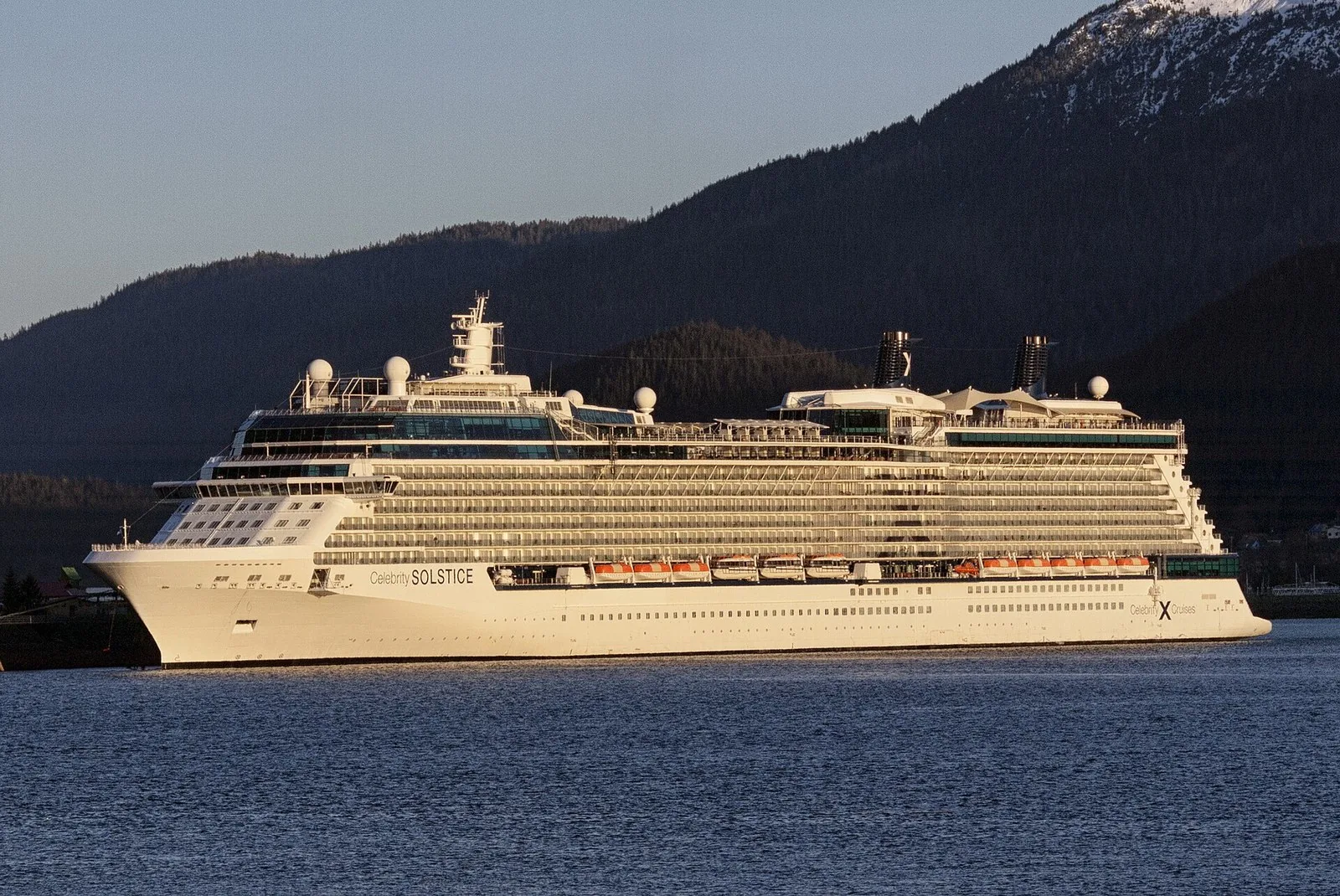
- Celebrity Solstice in Juneau (2015): photo by Gillfoto, via Wikimedia Commons (CC BY-SA 4.0)
- Passengers on deck: photo by National Park Service, Alaska Region, via Wikimedia Commons (Public domain)
- Alaska cruise region map: map by Kmusser, via Wikimedia Commons (CC BY-SA 3.0); ferry routes removed; cruise ports, glacier-viewing areas and Denali added by Alaska Cruise Guide
- Celebrity Solstice in Juneau (2024): photo by TheTransitFanNY, via Wikimedia Commons (CC BY-SA 4.0)
- Dawes Glacier, Endicott Arm: photo by Richard Martin, via Wikimedia Commons (CC BY 2.0)
- Celebrity Solstice in Juneau (2026): photo by Z thomas, via Wikimedia Commons (CC BY 4.0)