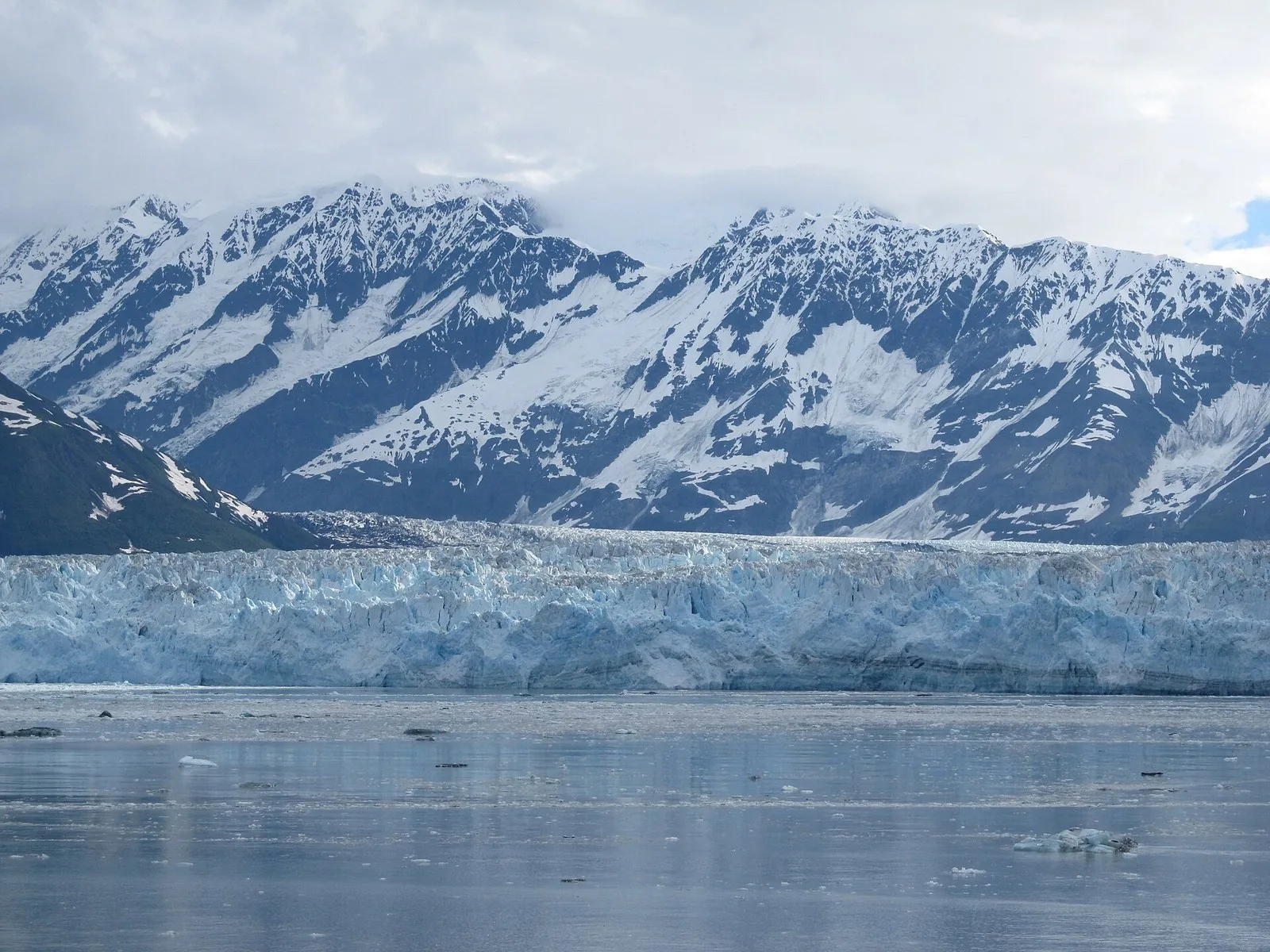
Hubbard Glacier is North America’s largest tidewater glacier, and on a clear day it’s the biggest single thing you’ll see from an Alaska cruise ship. Its face is about 600 feet tall, roughly 350 feet above the water and 250 feet below, and it fills the head of Disenchantment Bay near Yakutat on the Gulf of Alaska coast. Ships don’t dock. They spend part of a scenic cruising day in the bay, and how close they get depends on the ice.
This page is for cruise passengers deciding between an itinerary with Hubbard and one with Glacier Bay, and for anyone getting ready for a Hubbard day at sea. The caveat that matters: nobody can promise you a distance or a view. Ice in the bay, fog and the captain’s judgment decide how close you get, and some ships turn back early. Last updated October 23, 2026. Every price, fee and schedule below is dated, and the sources are listed at the end.
Hubbard is the headline of many Gulf of Alaska itineraries and one of the big set pieces of any Alaska glacier cruise. Here’s what to expect, which 2027 cruises go there and how it compares with the alternatives.
Hubbard Glacier at a Glance
| Question | Short answer |
|---|---|
| Where is it? | At the head of Disenchantment Bay, off Yakutat Bay on the Gulf of Alaska coast, inside Wrangell-St. Elias National Park and Preserve |
| How big? | 76 miles long and 7 miles wide, with a face about 600 feet tall, per the National Park Service |
| Where does it start? | Near Mount Logan (19,850 feet) in Canada’s Yukon |
| Advancing or retreating? | Advancing for the past century; the Park Service calls it stable and still thickening |
| How do you see it? | From the ship during scenic cruising; there’s no dock and no going ashore |
| How close do ships get? | No official figure; ice and the captain decide |
| Which cruises go? | Mostly one-way Gulf of Alaska cruises between Vancouver and Seward or Whittier, plus some longer round trips |
| Passport needed? | Not for Hubbard itself; the bay is in U.S. waters |
| Watch out for | Fog, heavy ice, cold wind on deck, and seal pupping season in May and June |
Which Cruises Visit Hubbard Glacier in 2027?
Hubbard sits on the Gulf of Alaska, west of the Inside Passage, so it mostly appears on one-way cruises that sail between Vancouver and the Anchorage-area ports of Seward and Whittier, and on longer round trips. Many seven-day Seattle and Vancouver round trips pick Glacier Bay or Endicott Arm instead, though some include Hubbard. Here’s what the lines had announced for 2027 by late September 2026.
| Line | 2027 Hubbard sailings announced |
|---|---|
| Holland America | Southbound “Glacier Discovery” sailings (Whittier to Vancouver) on Nieuw Amsterdam and Westerdam add Hubbard; the 14-day “Great Alaska Explorer” from Seattle on Noordam includes it |
| Princess | Lists Hubbard as one of its four glacier-viewing areas, alongside Glacier Bay, College Fjord, and Endicott Arm and Dawes Glacier |
| Royal Caribbean | Anthem of the Seas’ 7-night one-way cruises between Vancouver and Seward |
| Norwegian | Norwegian Jade’s cruises between Vancouver and Whittier include Hubbard or Glacier Bay |
| Celebrity | Features Hubbard on its Alaska itineraries |
| Viking | The 11-day “Alaska and the Inside Passage” between Vancouver and Seward, which lists Hubbard rather than Glacier Bay |
| Virgin Voyages | Reported to include Hubbard on a longer 12-night Brilliant Lady voyage |
Two cautions. First, “includes Hubbard or Glacier Bay” means you get one, not both, so check the specific sailing. Second, Cunard, which sailed Alaska with Hubbard in 2026, reportedly has no Alaska season in 2027. If Hubbard is a must, filter by itinerary, not by line.
Northbound or southbound?
On one-way cruises, the direction can decide which glaciers you get. Holland America’s 2027 “Glacier Discovery” is the clearest example: both directions include Glacier Bay, but the northbound sailings (Vancouver to Whittier) add College Fjord, while the southbound sailings (Whittier to Vancouver) add Hubbard. Same ship, same ports, a different big glacier. Other lines vary their one-way routes in similar ways, so read the day-by-day itinerary for your exact sailing date rather than the cruise’s headline description.
Direction also changes the rhythm of the trip. Southbound, Hubbard usually comes early in the cruise, while you’re still adjusting to the ship and the time zone, and the Inside Passage ports follow. Northbound, it tends to fall near the end, as a finale before you reach Seward or Whittier and head inland. Neither is better. Just know which one you’ve booked, so you’re not surprised to find yourself on deck in a parka on your second morning.
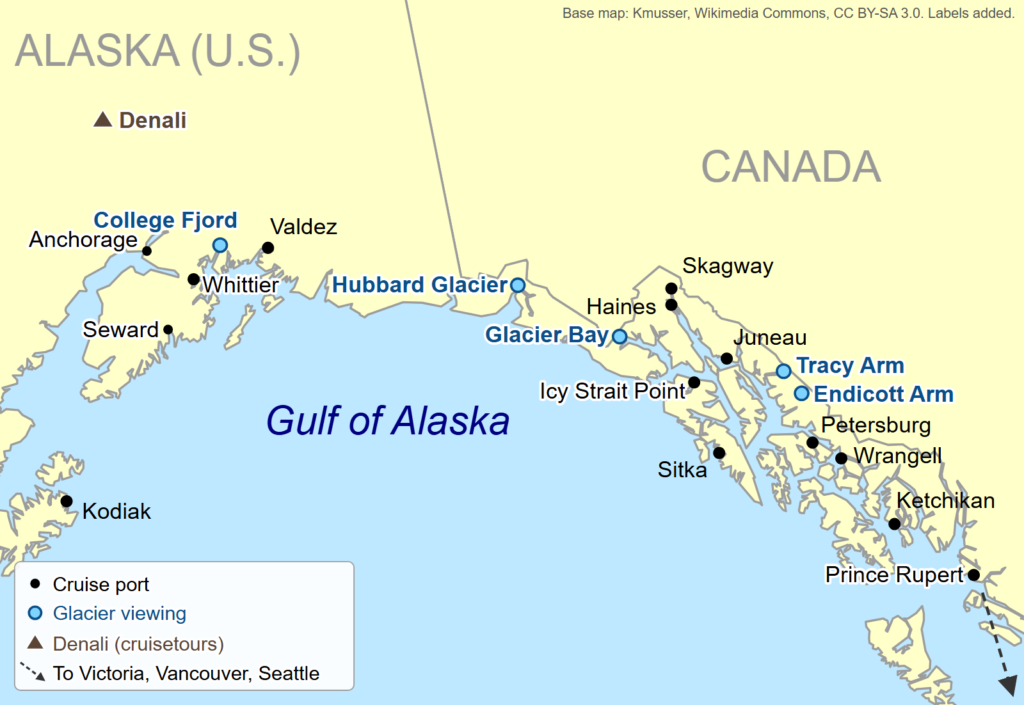
Where Is Hubbard Glacier? Yakutat Bay and Disenchantment Bay
Hubbard begins high in the St. Elias Mountains near Mount Logan, Canada’s highest peak at 19,850 feet, and flows down into Alaska to end in Disenchantment Bay, a narrow arm at the top of Yakutat Bay. The nearest town is Yakutat, which few cruise ships visit. The glacier and the bay lie within Wrangell-St. Elias National Park and Preserve, where glaciers cover about 35% of the land. The Park Service calls it the nation’s largest glacial system.
So is it an Alaska glacier or a Canadian one? Both. The ice is born in the Yukon and meets the sea in Alaska, which is why “Hubbard Glacier Canada” turns up in searches. You don’t cross a border to see it, and you don’t need a passport for the visit itself.
The name Disenchantment Bay goes back to 1792, when, by most accounts, the Spanish expedition of Alessandro Malaspina sailed in hoping it was the Northwest Passage and found a wall of ice instead. The bay was already home water for the Tlingit people of Yakutat, whose seal hunting on the ice continues today and whose concerns about ship traffic shaped how cruise ships behave here (more on that below).
How Big Is Hubbard Glacier?
The Park Service figures are simple and hard to picture: 76 miles long, 7 miles wide, and a terminal face about 600 feet tall, with roughly 350 feet above the waterline and 250 feet below. The visible cliff alone is taller than a 30-story building, and it runs for miles. From the deck, the scale is confusing at first. The ice looks close and small until a slab the size of an apartment block drops off and you realize how far away it is.
That underwater portion matters too. Some icebergs don’t fall from the top of the face; they break off below the waterline and shoot to the surface, often with more force than the ones that fall. Glacier guides call these shooters, and they’re one reason ships keep their distance.
How Close Do Cruise Ships Get to Hubbard Glacier?
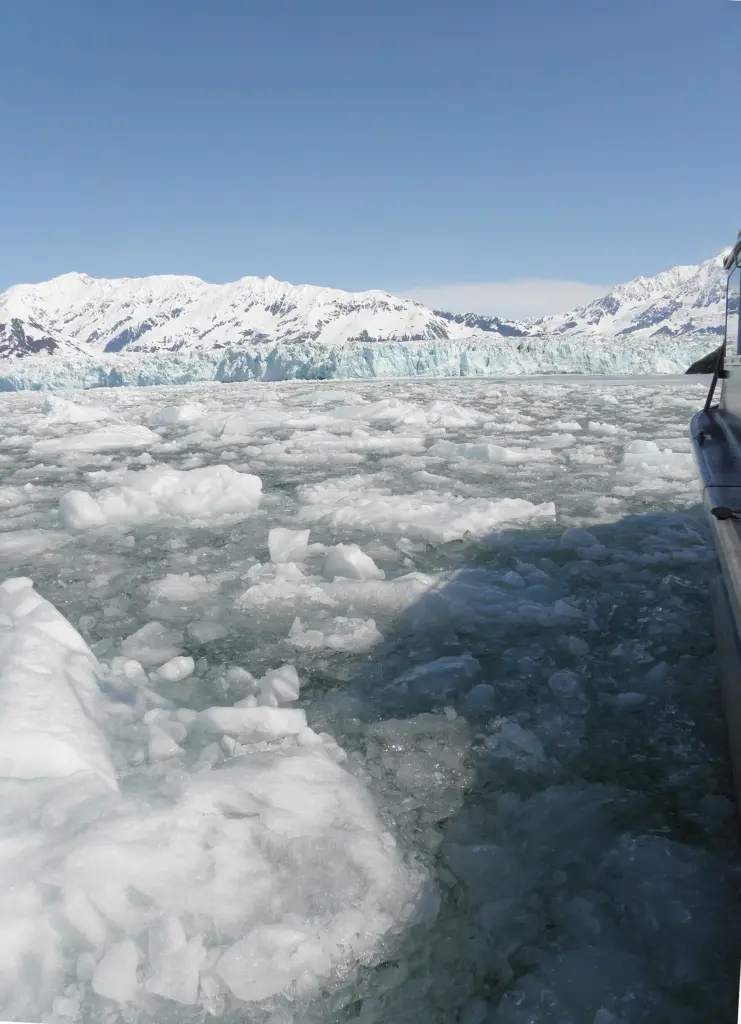
You’ll read claims online that ships get within a quarter mile of the face. We found no official figure to back that up, and nobody can promise it. The approach depends on three things:
- Ice in the bay. Hubbard calves constantly, and the icebergs and smaller brash ice pack Disenchantment Bay. On heavy-ice days, big ships stop well short of the face, sometimes miles out.
- Wildlife. Harbor seals haul out on the floating ice, and in pupping season ships are asked to stay well back (see below).
- The captain’s judgment. Visibility, wind, currents and the ship’s schedule all come into it. Some sailings turn back early.
When conditions are good, ships usually hold position in front of the face and slowly turn so that both sides of the ship get a look. On poor days, you may see the glacier across a mile or more of ice from the mouth of Disenchantment Bay, which is still worth the cold fingers. Verdict: never choose a cruise on a promised distance. Choose it on the itinerary, and treat a close approach as luck.
How a Hubbard Day Unfolds
Your ship’s daily program will list a window for glacier viewing, and the bridge will announce the approach. The visit tends to follow the same shape:
- Yakutat Bay. The ship turns in from the open Gulf of Alaska. On a clear day the St. Elias Mountains fill the horizon, some of the highest coastal peaks in the world. Go on deck now; the light and the mountains are often best before the ice.
- Into Disenchantment Bay. The water narrows and changes color, milky with glacial silt, and the first icebergs appear. Seals and seabirds start to show on the floating ice.
- The ice field. The ship slows to a crawl as the ice thickens. You’ll hear it bumping along the hull. This is when the captain decides how far in to go.
- At the face. The ship holds position and slowly turns so that both sides get their view. This is the time to pick a spot, stay put and wait for calving.
- The exit. The ship turns back down the bay. Look back once you’re clear of the ice; the full width of the face is often easier to take in from a distance.
The whole visit, from Yakutat Bay and back, takes up a good part of the day, so plan your spa appointment or trivia for later. If your ship arrives early in the morning, set an alarm; the approach is worth losing sleep over.
Calving and White Thunder
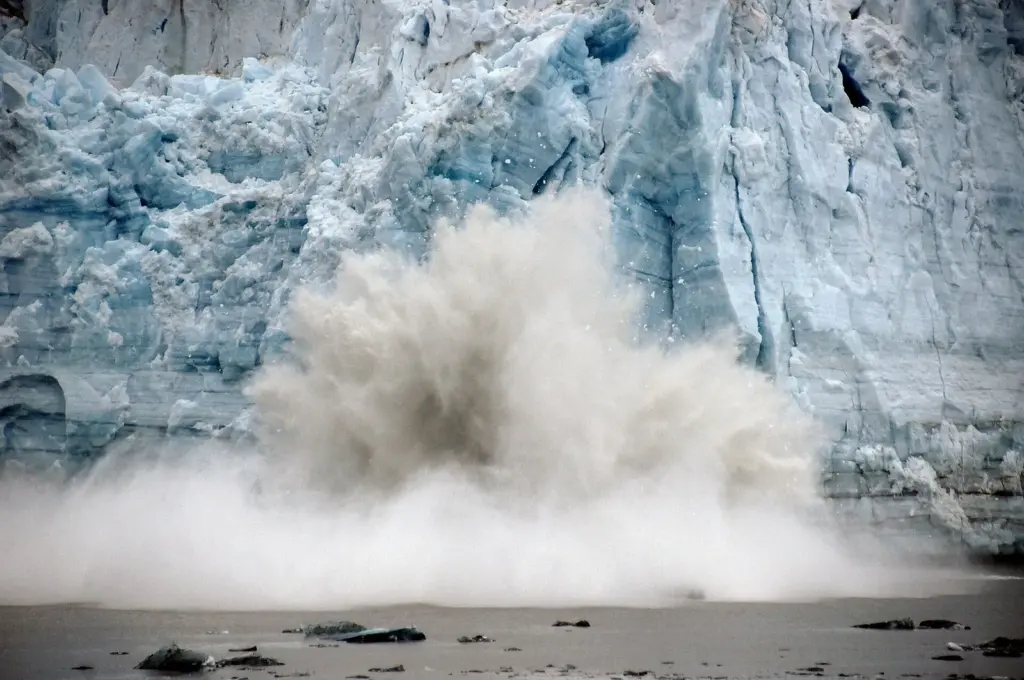
Calving is the reason people stand on a freezing deck for two hours. As the glacier pushes into the sea, the face fractures, and columns of ice lean out and fall. The Park Service notes that at tidewater faces, blocks of ice up to 200 feet high may break away, and the icebergs they make can last a week or more.
The sound is the part nobody forgets. Glacier ice cracks, rumbles and booms, which is why visitors reach for the word thunder, and many crews call it white thunder. Because sound travels far slower than light, you’ll see a slab fall and hear it seconds later; from about a mile out, the delay is close to five seconds. If you hear a crack, look at the face straight away. You have a moment before the splash.
A few tips for catching it:
- Pick a section of the face with leaning columns or deep blue cracks and watch it, rather than scanning the whole width.
- Keep your camera in video mode with the shot framed. Most calving is over before you can raise a phone.
- Stay out for the whole visit. Calving comes in bursts, and the best event often happens after half the deck has gone inside.
For the science of why glaciers calve and where else you’ll see it, our glacier calving explainer goes deeper.
Hubbard Glacier Is Advancing: Russell Fiord and the Ice Dam
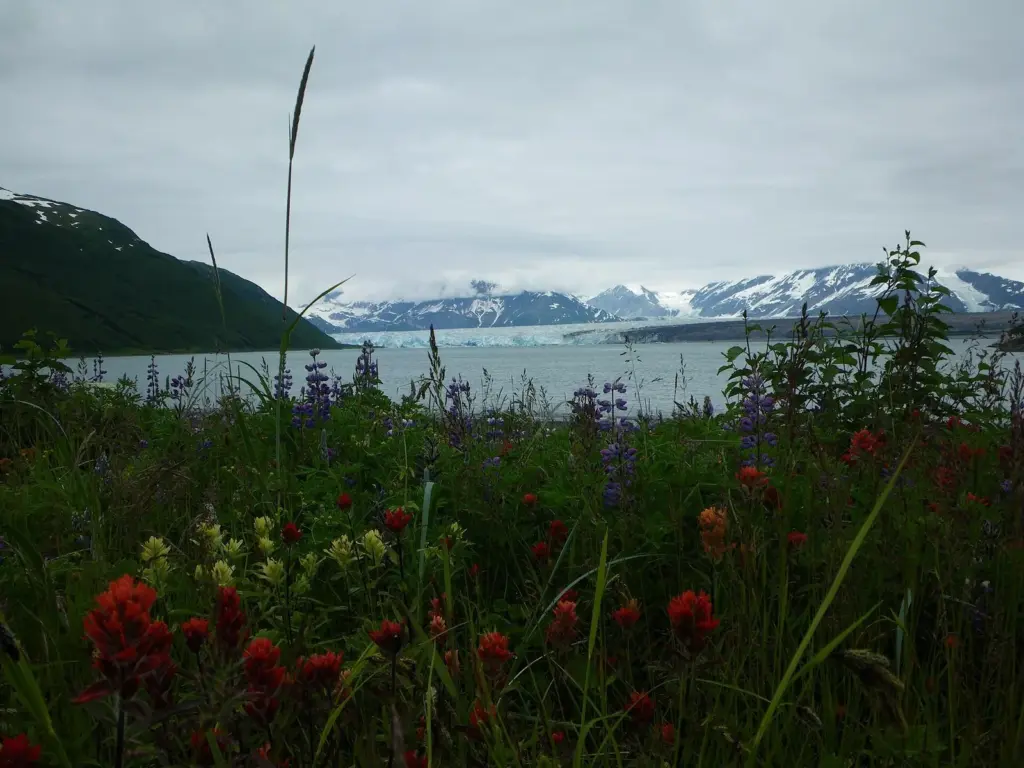
Hubbard is the famous exception in a state of shrinking glaciers. The Park Service says that unlike most Alaska glaciers, it has advanced over the past 100 years, and it describes the glacier as currently stable and still thickening. Researchers writing in the Journal of Glaciology note that it has been thickening and advancing since it was first mapped by the International Boundary Commission in 1895.
Why? Hubbard is fed by vast icefields in the St. Elias Mountains, and scientists describe its advance as driven more by the mechanics of calving at its face than by short-term climate swings. It’s a reminder that each glacier has its own budget. So when people ask whether Alaska glaciers are melting, the honest answer is yes, overwhelmingly, with Hubbard as the best-known glacier moving the other way. Our page on the question are Alaska glaciers melting has the statewide picture.
The advance has real consequences. In 1986 and again in 2002, Hubbard pushed across to Gilbert Point and dammed Russell Fiord, turning it into a lake that began to rise. Each time, the ice dam eventually broke and the fiord reconnected with the sea. A Journal of Glaciology update has asked whether another closure is in the making. If it happens during your cruise, you’ll be watching geology in real time.
Harbor Seals, Pupping Season and Why Ships Keep Their Distance
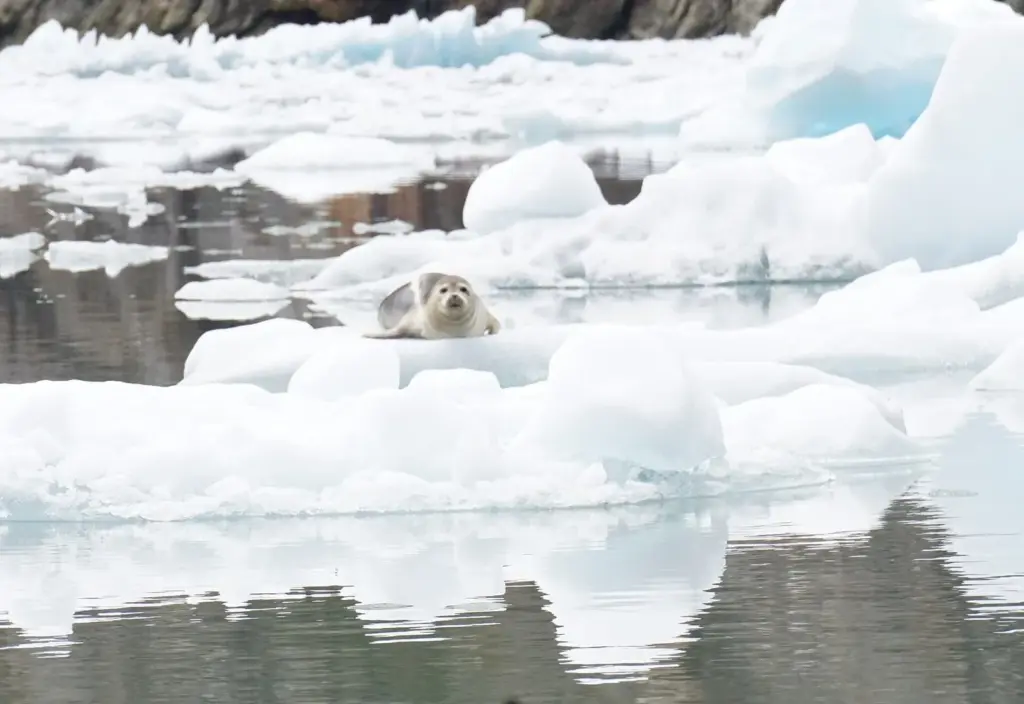
The dark dots on the ice in front of Hubbard are often harbor seals. Disenchantment Bay is one of Alaska’s important glacial-ice pupping areas, and NOAA Fisheries reporting says seals have probably raised pups there for about a thousand years, with pupping in May and June.
Ships and seals don’t mix well. NOAA Fisheries researchers saw seals on the ice flush into the water in reaction to ships as far out as a quarter mile, and found that a single vessel can cause up to 14% of seals to flush. An earlier study of cruise ships in the bay found that seals approached to about 100 meters were 25 times more likely to go into the water than seals approached to about 500 meters. Pups pushed into cold water burn energy they need.
The Tlingit Tribe of Yakutat raised the alarm, pointing to a roughly tenfold rise in tour-vessel visits over 30 years and the effect on cultural seal hunting. In 2015 NOAA Fisheries issued approach guidelines for vessels in glacial fjords to reduce disturbance, and in June 2016 and 2017 it satellite-tagged 73 pups and two mothers in the bay to learn more. What it means for you: an early-season ship may hold farther back than you’d like. Bring binoculars and count it as a price worth paying.
Hubbard Glacier Weather: Fog, Wind and What to Wear
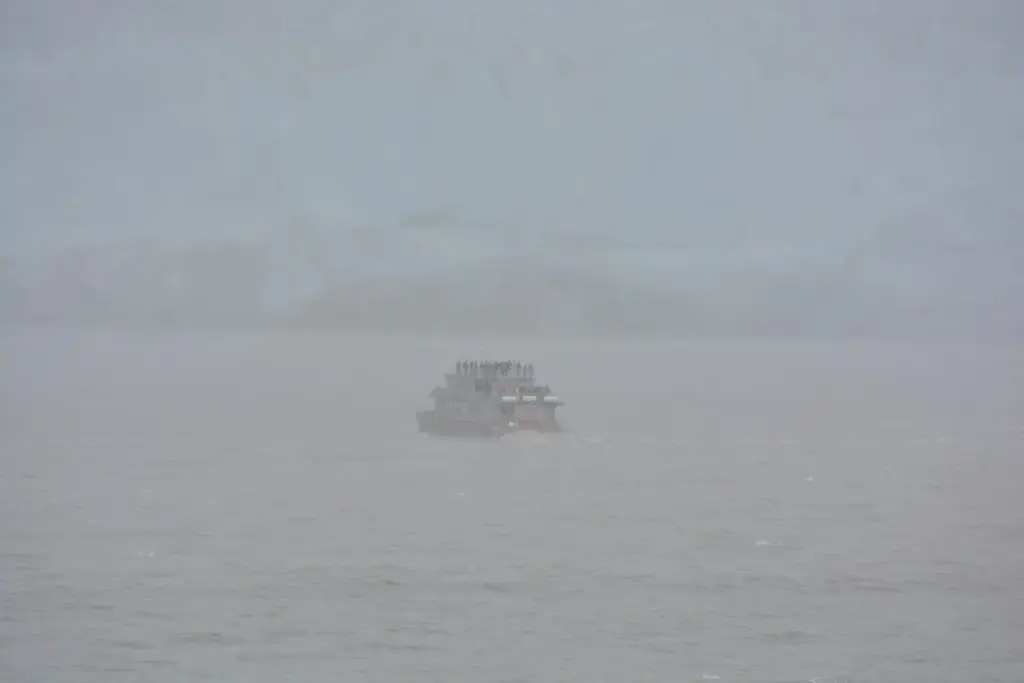
The Gulf of Alaska coast gets weather straight off the ocean, and Disenchantment Bay adds cold air pouring off miles of ice. Expect cloud and drizzle at least as often as sunshine, and fog that can hide the face completely before lifting an hour later. The National Weather Service forecast for Yakutat is the one to check the evening before; your ship’s bridge will be watching the same thing.
Dress as if it’s early spring, whatever the calendar says: a warm hat, gloves, a windproof and waterproof shell over a fleece, and shoes with grip for wet decks. Air moving off the glacier feels noticeably colder than the open sea, and you’ll be standing still for a long time. Many ships hand out hot drinks on deck during glacier viewing; don’t count on it, but don’t turn it down.
As for timing, there’s no bad month, only trade-offs. May and June bring snow on the peaks and seal pupping, which can keep ships farther back. July and August usually have the most daylight and the mildest air. September can be clear and crisp or thoroughly gray.
Where to Watch From the Ship
How scenic cruising in Alaska works on your ship depends on the line, but the same rules apply at Hubbard:
- Go forward early. If your ship opens the bow or a forward deck for glacier viewing, get there for the approach through Disenchantment Bay. The ice field and the first view of the face are half the show.
- Don’t fight for the rail at the face. The ship turns in front of the glacier, so both sides get their turn. Pick a spot on an upper deck and let the view come to you.
- A balcony is a bonus, not a must. It gives you a warm retreat and a private view during the turn, but you’ll still want the open decks for the full panorama.
- Listen to the commentary. Many lines bring on a naturalist or run narration on deck. It’s the best way to learn what you’re looking at.
- Bring binoculars. For seals on the ice, birds and the texture of the face.
A few sailings also offer a small-boat trip from the ship toward the face, weather permitting, like the local boat that met Holland America’s Westerdam in August 2023. If your line sells one, it’s the closest look you’ll get.
Photographing the Face
Hubbard is a hard subject: a huge, bright, low-contrast wall of blue and white under gray sky. A few habits help.
- Brighten the exposure. Cameras and phones see all that ice and darken the picture, so the face comes out gray. Tap on the ice to set exposure, or dial in a little plus compensation.
- Give it scale. The face means nothing without a reference. Include the ship’s rail, a fellow passenger, an iceberg or a seal on the ice.
- Zoom in on the detail. The deep blue seams, the leaning columns and the dirty bands of rock carried down the valley make better photos than yet another wide shot.
- Shoot video for calving. Frame a section of face and let it run. Pull stills from the video afterward.
- Protect your gear. Drizzle and spray fog lenses, and cold drains batteries fast. Keep a spare battery and a lens cloth in an inside pocket.
Hubbard Glacier vs Glacier Bay: Which Is Better?
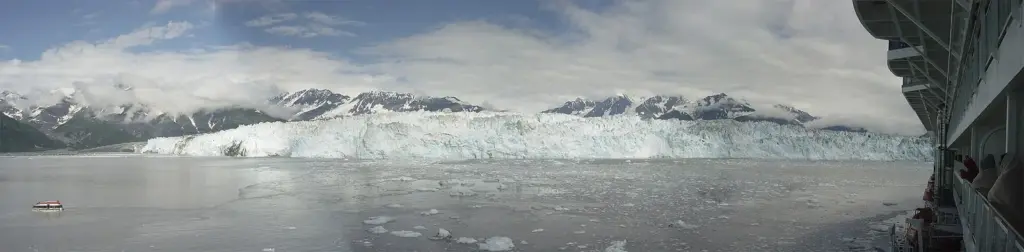
This is the question behind most Hubbard searches, and the full glacier bay vs hubbard glacier comparison has its own page. The short version:
| Hubbard Glacier | Glacier Bay National Park | |
|---|---|---|
| What you see | One enormous, advancing glacier | Several tidewater glaciers and a long fjord system |
| Time | Part of a scenic cruising day | A full day, typically 9 to 10 hours, with about an hour at a glacier face |
| Rangers aboard | No | Yes, National Park Service rangers board |
| Who can go | Lines without Glacier Bay permits, such as Royal Caribbean and Celebrity, as well as permit holders | Only concession holders: Princess, Holland America, Norwegian, Seabourn, Cunard and Viking are listed |
| Ship limits | Set by ice and weather on the day | No more than two cruise ships a day |
| Typical itinerary | One-way Gulf of Alaska cruises | Round trips and one-way cruises from the concession lines |
Verdict: Glacier Bay wins on variety, context and the ranger program. Hubbard wins on sheer scale and the drama of a single face. If you can get both on a one-way cruise, take it. If you have to pick, first-timers usually get more from Glacier Bay, and repeat visitors often prefer Hubbard.
Is It Worth Choosing an Itinerary for Hubbard?
For many people, yes. A one-way Gulf of Alaska cruise with Hubbard gives you the Inside Passage ports plus a glacier on a scale you won’t see elsewhere, and it sets you up for a land trip to Denali from Seward or Whittier. If you’re weighing two otherwise similar sailings and one includes Hubbard, that’s a good tiebreaker.
It’s less compelling if your cruise already has a full day in Glacier Bay and you’d be giving up a port to get Hubbard, or if a one-way cruise means an expensive open-jaw flight home. And if you’re sailing in May or early June, remember that seal pupping and heavy ice can keep ships farther back. Verdict: worth planning around, never worth overpaying for, because the weather gets the final vote.
Mistakes to avoid on a Hubbard day
- Sleeping through the approach. Yakutat Bay and the ice field are half the experience.
- Dressing for a sea day. The deck in front of a glacier is winter. Hat, gloves and a windproof layer.
- Going inside after ten minutes. The biggest calving often comes after the crowds thin out.
- Watching through a phone. Take your video, then put the phone down and listen.
- Assuming a canceled approach means bad planning. Ice and fog stop ships every season. The captain isn’t being cautious for fun.
Other Glaciers You Might See on the Same Cruise
Hubbard is rarely the only ice on the itinerary. On one-way cruises, College Fjord in Prince William Sound often features on northbound sailings, with its line of glaciers named after East Coast colleges. Inside Passage days usually include Tracy Arm Fjord or Endicott Arm, and since the 2025 Tracy Arm tsunami many lines have been using Endicott Arm and Dawes Glacier instead. From Juneau, a Tracy Arm tour from Juneau gets you into the fjord by small boat.
If your cruise starts or ends in Seward or Whittier, there’s more ice on land. From Whittier, the 26 Glacier Cruise tours Prince William Sound by catamaran; from Seward, Kenai Fjords tours run out to tidewater glaciers in the national park, and Exit Glacier is a short drive from town. Portage Glacier sits beside the road between Anchorage and Whittier. Put two or three of these together, and you’ll see more glaciers in a week than most people see in a lifetime.
Hubbard Glacier FAQ
How close do cruise ships get to Hubbard Glacier?
There’s no official figure, and nobody can promise one. Ice in Disenchantment Bay, fog, wildlife and the captain’s judgment decide the approach. On good days ships hold position in front of the face; on heavy-ice days they may stop well out in the bay, and some sailings turn back early.
Is Hubbard Glacier in Alaska or Canada?
Both. The glacier starts near Mount Logan in Canada’s Yukon and flows 76 miles to meet the sea in Disenchantment Bay, Alaska, inside Wrangell-St. Elias National Park and Preserve. Cruise ships view it from U.S. waters, so you don’t need a passport for the Hubbard visit itself.
Is Hubbard Glacier advancing or retreating?
Advancing. The National Park Service says Hubbard has advanced over the past 100 years and describes it as stable and still thickening, unlike most Alaska glaciers. In 1986 and 2002 it advanced far enough to dam Russell Fiord, and each time the ice dam eventually broke.
Can you get off the ship at Hubbard Glacier?
No. There’s no cruise port at Hubbard Glacier. Ships spend part of a scenic cruising day in Yakutat and Disenchantment bays and view the face from the water. A few sailings sell a small-boat trip from the ship toward the glacier, weather permitting, but most passengers watch from the decks.
Which cruise lines go to Hubbard Glacier?
For 2027, Holland America, Princess, Royal Caribbean, Norwegian, Celebrity and Viking have announced itineraries that include it, mostly one-way cruises between Vancouver and Seward or Whittier. Some sailings offer Hubbard or Glacier Bay rather than both, so check the specific cruise before you book.
What is the best month to see Hubbard Glacier?
July and August usually bring the longest days and mildest air. May and June add snow on the peaks but coincide with seal pupping, when ships may keep farther back. September can be clear or gray. Weather on the day matters far more than the month.
What is white thunder at Hubbard Glacier?
White thunder is the name for the crack and boom of ice breaking off the glacier face. Because sound travels slower than light, you see the ice fall before you hear it; from about a mile away the delay is close to five seconds. Some icebergs also break off underwater and shoot to the surface.
Related Alaska Cruise Guides
Sources and How We Checked
We checked the prices, rules, schedules and ship deployments in this guide against the sources below on September 26, 2026, and we log each one in our research database with the date it was checked. Cruise lines change ships, fares and fees every season, so confirm anything that affects your booking with the line or the agency concerned. Alaska Cruise Guide (AlaskaCruise.org) is an independent publication. It is not affiliated with any cruise line, port, tour operator or tourism office, and no one paid to be included.
- aboardtheworld.com: Hubbard Glacier
- cambridge.org: Hubbard Glacier
- Celebrity Cruises: Celebrity Cruises
- deeparrival.com: Cunard
- Holland America Line: Holland America Line
- National Park Service: Glacier Bay cruise permits
- National Park Service: Glacier Bay glaciers
- National Park Service: Glacier Bay cruise visit
- National Park Service: Hubbard Glacier
- NOAA Fisheries: Disenchantment Bay harbor seals
- NOAA Fisheries: Disenchantment Bay harbor seals
- NOAA Fisheries: Disenchantment Bay harbor seals
- Norwegian Cruise Line: Norwegian Cruise Line
- PR Newswire (line press release): Royal Caribbean
- Princess Cruises: Princess Cruises
- science.nasa.gov: Hubbard Glacier
- vikingcruises.com: Viking
- virginvoyages.com: Virgin Voyages
Photo Credits
- Hubbard Glacier from a cruise ship: photo by Explorer1940, via Wikimedia Commons (CC BY-SA 4.0)
- Alaska cruise region map: map by Kmusser, via Wikimedia Commons (CC BY-SA 3.0); ferry routes removed; cruise ports, glacier-viewing areas and Denali added by Alaska Cruise Guide
- Boat in Hubbard Glacier ice, Russell Fiord: photo by Forest Service Alaska Region, USDA, via Wikimedia Commons (Public domain)
- Hubbard Glacier calving: photo by Bernard Spragg. NZ from Christchurch, New Zealand, via Wikimedia Commons (CC0)
- Hubbard Glacier from Marble Point, Russell Fiord: photo by Forest Service Alaska Region, USDA, via Wikimedia Commons (Public domain)
- Harbor seal on glacial ice, Tracy Arm: photo by Dankarl, via Wikimedia Commons (CC BY-SA 4.0)
- St. Theodosius near Hubbard Glacier: photo by Photo by Joe Mabel, via Wikimedia Commons (CC BY-SA 4.0)
- Hubbard Glacier from a cruise ship: photo by Kowloonese at en.wikipedia, via Wikimedia Commons (CC BY-SA 3.0)