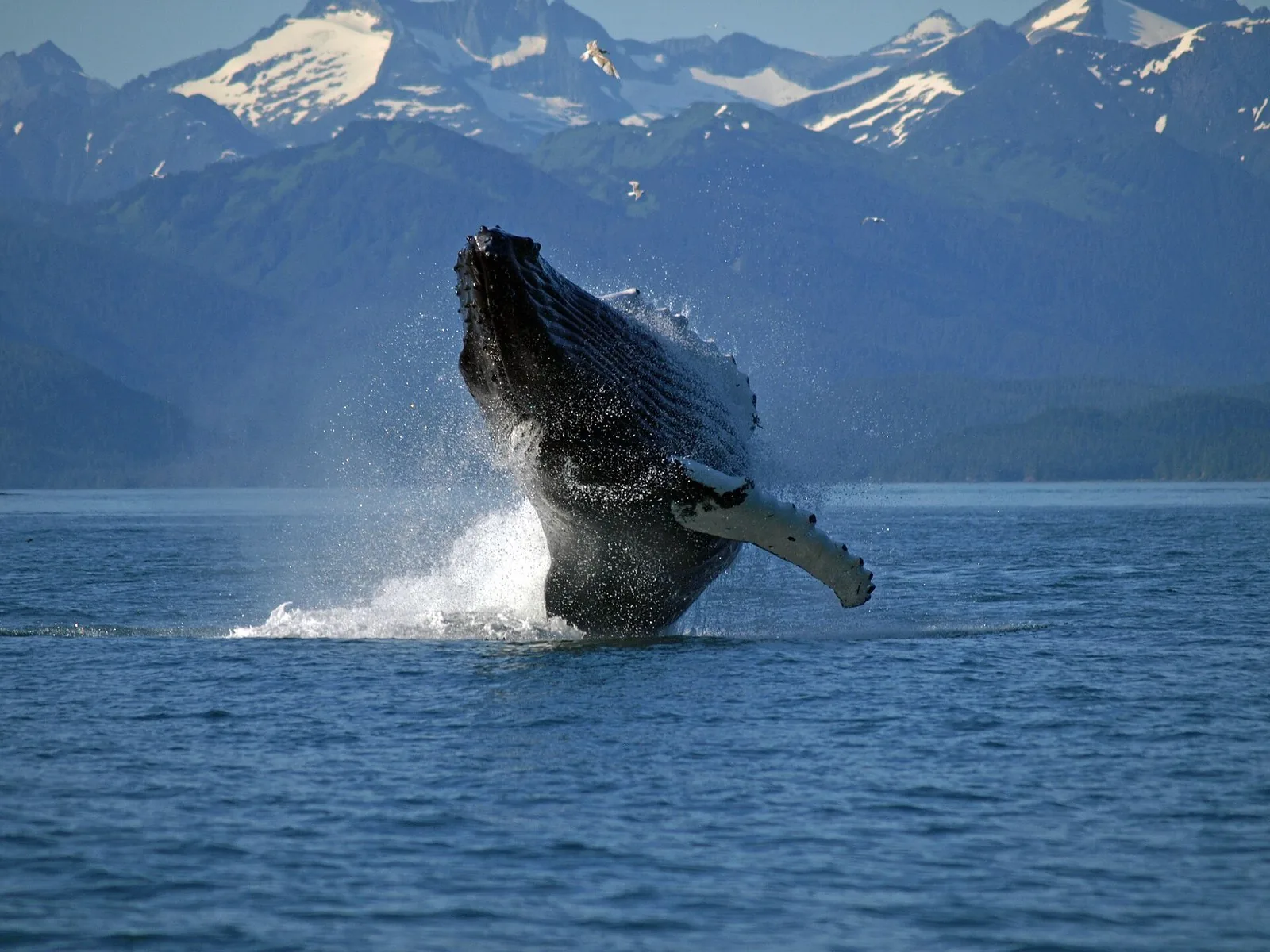
Juneau whale watching is the most dependable wildlife tour on an Alaska cruise. Humpback whales feed in the waters around Juneau all summer, tours leave from Auke Bay about a 30-minute drive from the cruise docks, and a standard trip takes three to four hours door to door with two to three hours on the water. In 2026 the common shared tours cost about $155 to $199 per adult, and several operators advertise money back if you don’t see a whale between mid-May and mid-September.
This page is for cruise passengers deciding which Juneau whale tour to book, how long it really takes and whether it fits your ship’s hours. The one caveat that matters: guarantees, boat sizes and the actual time on the water vary a lot between operators, so the cheapest ticket isn’t always the best value. For everything else to do in port, see our guide to things to do in Juneau. Last updated November 1, 2026. Every price, fee and schedule below is dated, and the sources are listed at the end.
Juneau whale watching at a glance
| Question | Short answer | Why it matters |
|---|---|---|
| Where do boats leave from? | Auke Bay, north of downtown | Allow about 30 minutes each way by bus or van |
| How long does it take? | 3 to 4 hours for a standard tour, about 5 with the Mendenhall Glacier | Check it against your all-aboard time before you book |
| What does it cost? | $155 to $199 per adult for common shared tours in 2026 | Private boats start in the thousands |
| Will I see a whale? | Humpbacks are very likely from mid-May to mid-September | Several operators refund you if you don’t |
| Orcas? | Possible but not common | Book for humpbacks and treat orcas as a bonus |
| Best months | June through August; June and July for bubble-net feeding | May and September work, with fewer whales and more rain |
| Big boat or small? | Small for photos and naturalist time, big for stability and price | Both see the same whales |
How Juneau whale watching works
Almost every Juneau whale tour follows the same pattern. You meet a bus or van near the cruise docks, ride about half an hour north along the Gastineau Channel and past the Mendenhall Valley to Auke Bay, and board a boat in the harbor there. The boat then heads into the channels north and west of Juneau, where the captains share sightings by radio and go where the whales are feeding that day. After two to three hours on the water, you’re driven back to town.
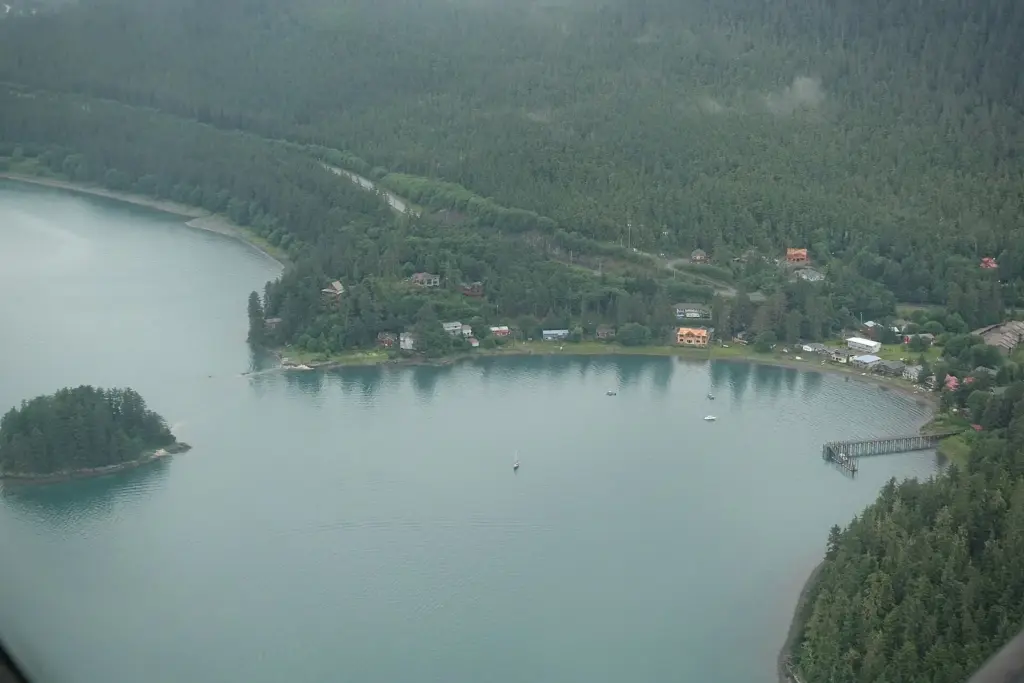
Why Auke Bay and not downtown? Because the whales aren’t downtown. Juneau’s cruise docks sit on the narrow Gastineau Channel, and the productive feeding grounds are out in the wider waters beyond Auke Bay, around places like Shelter Island and toward Lynn Canal and Stephens Passage. Starting in Auke Bay puts you minutes from the whales instead of more than an hour.
Once a whale is found, the boat slows and stays at a legal distance. Federal rules make it illegal to approach within 100 yards of a humpback whale in Alaska waters, or to put a vessel in a whale’s path. A good captain shuts down the engines or idles and lets the whales set the pace. Some of the best encounters happen when a whale surfaces near a boat that’s sitting still, which is legal and lucky.
Here is how a typical 3.5-hour tour splits up, using Juneau Tours’ published 2026 timings as the example:
| Stage | Time | What happens |
|---|---|---|
| Check-in and boarding the bus | 10 to 15 minutes | Meet at the Mount Roberts Tramway parking lot on the waterfront |
| Drive to Auke Bay | About 30 minutes | Narration on the way; eagles are common |
| On the water | About 2 hours | Searching, watching, and a heated cabin between sightings |
| Drive back | About 30 minutes | Drop-off downtown |
That’s the thing most people don’t realize before they book: on a “3.5-hour whale tour,” about a third of the time is spent in a bus. It’s not a con, it’s geography. Just count it when you compare tours.
What you’ll see: humpbacks, orcas and the supporting cast
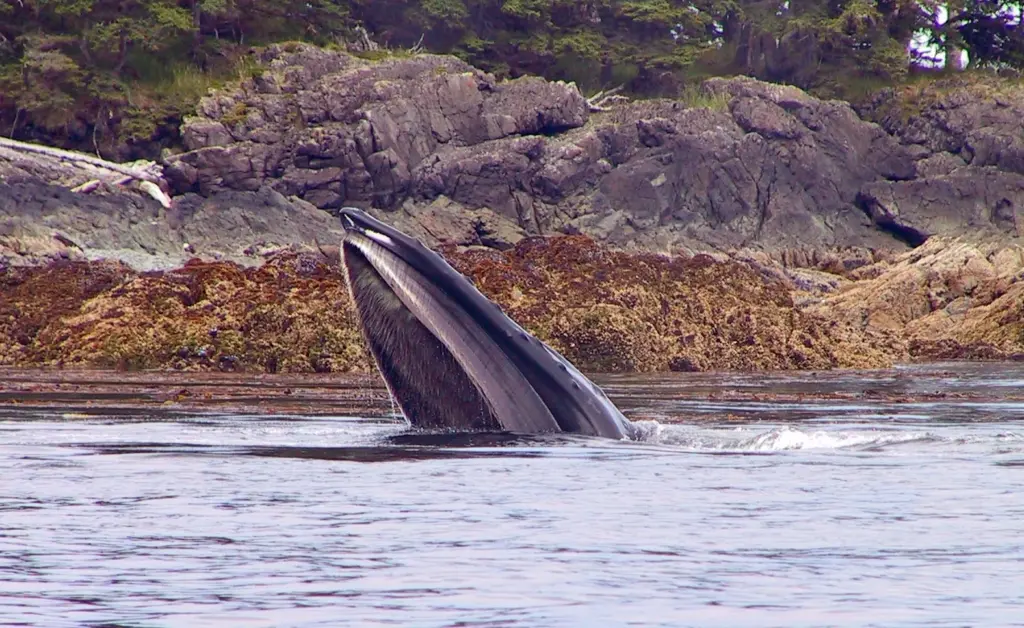
Humpback whales
Humpbacks are the reason these tours exist. Most of them winter near Hawaii, Mexico or Japan and migrate up to 3,000 miles each way to feed in Alaska over the summer. Adults average about 49 feet long and weigh around 35 tons, so even a calm whale surfacing to breathe is a big moment. The Alaska Department of Fish and Game says the Inside Passage has the state’s highest concentration of humpbacks, more than 500 whales.
What will they be doing? Mostly feeding, breathing and diving. You’ll see the blow first, a bushy spout that hangs in cool air, then the curved back, and on a deep dive the tail flukes lifting clear of the water. Each fluke’s black-and-white pattern is unique, and researchers use them to identify individual whales, so ask your naturalist whether they know the whale you’re watching. Breaches like the one at the top of this page do happen, but nobody can schedule them.
The headline act is bubble-net feeding. A group of humpbacks circles below a school of fish, blowing a ring of bubbles that traps the prey, then the whales lunge open-mouthed up through the middle together. ADF&G says June and July are the best months to see it. It isn’t guaranteed on any given day, and when it happens, you’ll hear the boat go silent.
Orcas
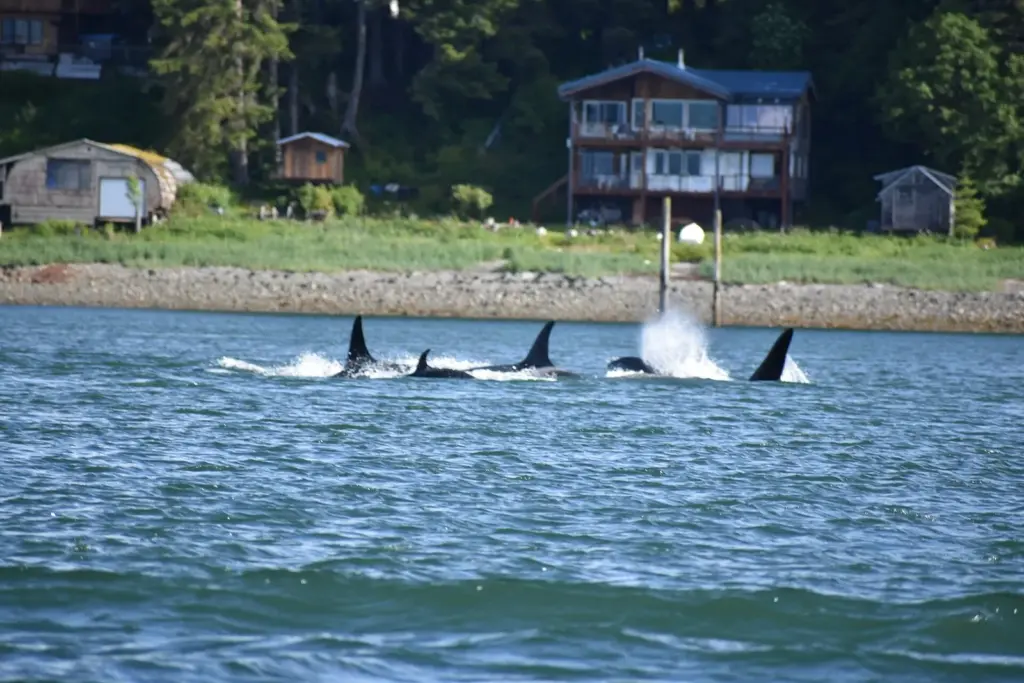
Orcas, or killer whales, do travel through Juneau’s waters, and Juneau operators describe them as an occasional sighting rather than a regular one. If a pod is around, the captains will hear about it on the radio and you’ll probably get a look. But don’t pick a tour or a sailing date hoping for orcas. Pick it for humpbacks and count orcas as luck.
Everything else
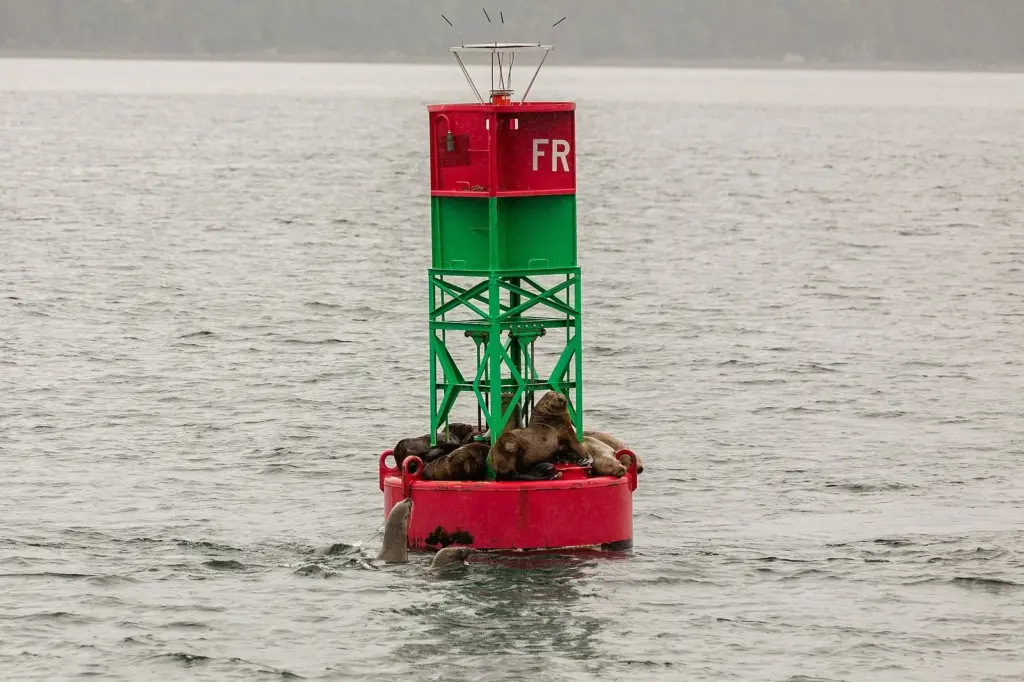
The supporting cast is reliable and often underrated. Steller sea lions haul out on navigation buoys and rocks, and they’re loud. Harbor seals pop up in the harbors. Bald eagles are everywhere, including on the drive to Auke Bay. Dall’s porpoises sometimes ride a boat’s bow wave, and black bears occasionally show up along the shoreline in the right season. A good naturalist turns these into part of the story instead of filler between whales.
When to go: Juneau whale watching by month
Juneau operators describe a whale season from late April to early November: the first humpbacks arrive in late April, numbers build through May, activity peaks from June through August, and whales start leaving for their breeding grounds in late September and October. For cruise passengers, that means every month of the season works, with some trade-offs.
| Month | Whale activity | Juneau average high (NOAA 1991-2020) | Average rain | Notes |
|---|---|---|---|---|
| May | Building; fewer whales early in the month | 57.6°F | 3.51 in | Guarantees on some tours start May 15 |
| June | High; bubble-net feeding season begins in earnest | 62.4°F | 3.82 in | Long daylight and the driest summer month |
| July | Peak | 64.0°F | 5.14 in | Busiest month for boats and ships |
| August | Peak | 62.9°F | 6.41 in | Rain picks up late in the month |
| September | Still good, tapering late | 56.1°F | 9.15 in | Wettest cruise month; some guarantees end September 15 |
Time of day matters less than you might think. Whales feed around the clock in summer, and morning and afternoon departures see the same animals. Choose the departure that fits your ship’s hours, and if you have a choice, take the earlier one so a delay doesn’t squeeze you against all-aboard.
The best Juneau whale watching tours, by type
Juneau has more whale-watching operators than most ports have tours of any kind. Several with active 2026 booking sites include Juneau Tours & Whale Watch, Harv & Marv’s Outback Alaska, Allen Marine Tours, Gastineau Guiding, Jayleen’s Alaska and Alaska Travel Adventures. Rather than rank companies whose boats and staff change from year to year, here are the five kinds of tour you can book and who each one suits.
1. The classic shared whale watch
This is the default: a bus to Auke Bay and a covered boat with a heated cabin, open viewing decks and a naturalist on the microphone. Juneau Tours’ standard whale watch cost from $155 per adult in 2026 for 3 to 3.5 hours, with about 2 hours on the water. Harv & Marv’s “Outback Experience Whale Watch” cost $159 per passenger for about 4 hours, including about 3 hours on the water, on a catamaran carrying up to 49 guests, with a complimentary shuttle from the cruise ship or a downtown meeting point and a Mendenhall Glacier viewing stop on the way.
Do the math on those two. At $155 for 2 hours on the water, you’re paying about $78 per whale-watching hour. At $159 for 3 hours, it’s about $53. Longer isn’t always better on a tight port day, but when two tours cost the same, compare the water time, not the total time.
Verdict: the right choice for most cruise passengers, and the one to book if this is your first time watching whales.
2. Small-boat whale watching
Smaller operators run boats that carry far fewer people. Jayleen’s Alaska, a woman-owned Juneau company, advertises 4-hour whale tours on custom six-passenger boats, and Gastineau Guiding keeps its small groups to 12 to 20 guests. You get a spot at the rail without elbowing, more questions answered by the guide, and a lower angle on the water that makes whales look bigger in photos.
The trade-offs are price, fewer seats (they sell out first on busy ship days), and a boat that moves more in a chop. If you’re prone to seasickness, a small boat is the wrong place to find out.
Verdict: worth the extra money for photographers, families with older kids and anyone who hates crowds. Book the day your cruise fares are paid, not the week before.
3. Whale watching plus the Mendenhall Glacier
Because Auke Bay is past the Mendenhall Valley, many operators sell a combo that adds time at the Mendenhall Glacier on the way. Juneau Tours’ Whale Watch & Mendenhall Glacier Combo cost from $199 per adult in 2026 and takes about 5 hours. That’s a lot of Juneau in one ticket: whales, the glacier and Nugget Falls, with transport handled.
The catch is time. Five hours plus your walk to the pickup plus a safety buffer is more than some Juneau port calls allow. If your ship is in for eight hours or more, this is excellent value. If it’s in for six, pick a whale-only tour and see the glacier another way. Our Mendenhall Glacier guide covers the other options.
Verdict: the best single tour in Juneau on a long port day, and a mistake on a short one.
4. Private whale-watching charters
If you’re traveling as a big family or group, a private boat can make sense. Juneau Tours sold private charters from $2,999 for a 24-passenger boat and $5,999 for a 49-passenger boat in 2026. Split 24 ways, the smaller boat works out to about $125 a head, cheaper than the shared tour, with your own timing and no strangers at the rail. Smaller private boats from the six-passenger operators cost less in total but more per person.
Verdict: a good deal for groups of 20 or more, and an expensive treat for anyone else.
5. The whale tour your cruise line sells
Your ship’s shore excursion desk sells Juneau whale tours too, run by the same local operators, often at a higher price. What the extra money buys is protection: the big lines typically promise that the ship will wait if a tour they sold runs late, and they won’t wait for you on a tour you booked yourself. Royal Caribbean, for example, says exactly that in its excursion policy.
Verdict: book through the ship if your time in Juneau is short or you’re uneasy about all-aboard math. Book directly with an operator if your port day is long, and save the difference for the salmon bake.
Boat size: big catamaran or six-passenger boat?
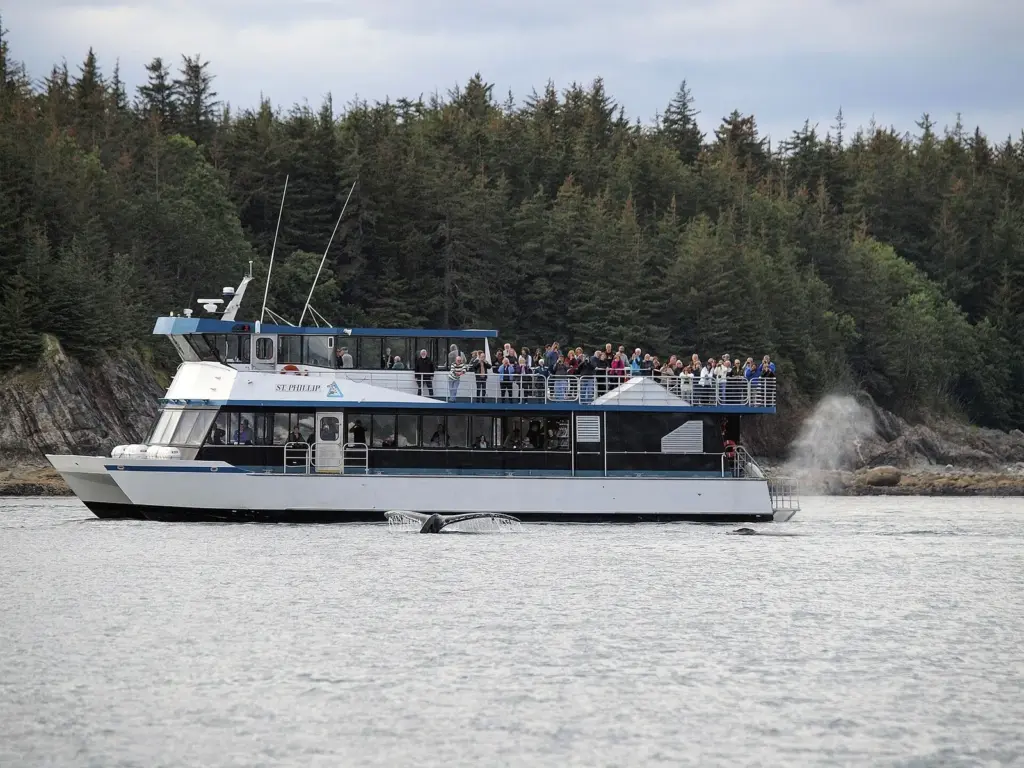
Whales don’t care what you arrived in. The same animals are visited by boats of every size, because the captains share sightings. What changes is your experience on board.
| Boat type | Typical capacity | Best for | Watch out for |
|---|---|---|---|
| Large catamaran or jet boat | About 40 to 49 guests | Stability, a heated cabin, restrooms, lower prices | Crowded rails when a whale is on one side |
| Mid-size small-group boat | About 12 to 20 guests | A balance of price, comfort and guide time | Sells out early on five-ship days |
| Six-passenger boat | 6 guests | Photography, questions, a private feel | More motion in wind; higher price per person |
Our take: if you get seasick or are traveling with grandparents, go big. If you’ve brought a long lens or your kids are old enough to sit still for two hours, go small. For everyone in between, the big boats deliver the same whales for less.
Sighting guarantees and refunds: read the fine print
Juneau’s whale odds are good enough that operators put money on them. Juneau Tours & Whale Watch and Harv & Marv’s both advertise whale guarantees for tours between May 15 and September 15, with your money back if no whale is seen. Not every guarantee is the same, though. At least one Juneau operator refunds a fixed $100 per adult and $50 per child instead of the full fare, which on a $159 ticket isn’t the same thing.
Before you book, get clear answers to four questions:
- What counts as a sighting? A distant blow on the horizon may count as “seeing a whale.”
- What’s the refund? The full fare, a fixed amount, a credit, or a free second trip you’ll never be able to use because your ship leaves at 2 p.m.?
- Which dates are covered? Mid-May to mid-September is common. Early-May and late-September sailings may fall outside it.
- What if the operator cancels for weather? Ask how and when you’re refunded, especially if you booked through a third party.
Honestly, the guarantee matters less than it looks. In the heart of summer, a tour that sees no whales at all is rare. What varies far more is how close, how many and how long, and no operator can guarantee those.
Getting to your tour from the cruise dock
Juneau’s big-ship berths are the AJ Dock, the Franklin Dock, the Cruise Ship Terminal and the Alaska Steamship Dock. The last three are downtown and walkable. The AJ Dock is reported to be about a mile south of downtown, roughly a 25-minute walk, with a shuttle reported at $5 for an all-day pass. Pickup points vary by operator: Juneau Tours meets at the parking lot of the Goldbelt Tram (the Mount Roberts Tramway), whose base station is at 490 S. Franklin Street, while Harv & Marv’s picks up at the cruise ship or a downtown meeting spot.
| Your berth | Getting to a downtown pickup | Time to allow |
|---|---|---|
| Alaska Steamship Dock | Walk | About 5 to 10 minutes |
| Cruise Ship Terminal or Franklin Dock | Walk | About 5 to 15 minutes |
| AJ Dock | Shuttle or a walk of about a mile | About 20 to 30 minutes |
| Operator pickup at your ship | Bus or van from the pier | Just be on time |
The all-aboard math
Work backward from your all-aboard time, not your departure time. Say your ship is in Juneau from 7 a.m. to 1:30 p.m. with all-aboard at 1 p.m.:
- Keep a 45- to 60-minute buffer: be back at the pickup point by noon.
- A 3.5-hour tour then has to start by 8:30 a.m.
- Add 15 minutes for check-in and, from the AJ Dock, another 20 to 30 minutes to reach the pickup.
- So you need to be off the ship by about 7:45 a.m. Doable, if you’re first in line at the gangway.
- The 5-hour Mendenhall combo would need a 7 a.m. start. That doesn’t work on this port day.
On a long Juneau call, say 7 a.m. to 9 p.m., you can take the combo, eat lunch downtown and still ride the tram. On a short one, pick the shortest whale tour that leaves early and let the rest go.
Seasickness, weather and what to wear
The waters around Auke Bay are inside waters, sheltered by islands and mountains, so they’re usually far calmer than the open ocean. Most people who get queasy on the ship feel fine on a whale boat. Wind can still kick up a chop, and small boats feel it most. If you’re prone to motion sickness, take your usual remedy before you board rather than after you feel ill, sit low and near the middle of the boat, and keep your eyes on the horizon, not your camera screen.
Dress for 50s and rain even in July. Juneau’s airport averages a high of 64.0°F in July and records measurable rain on about 16 to 22 days a month through the season, and it’s colder on the water, especially once the boat is moving. Wear a waterproof shell over a fleece, a hat and gloves you can use a phone in, and shoes with grip for wet decks. Binoculars help more than a big lens. Leave the umbrella on the ship: it’s useless on a moving boat.
Juneau whale watching combined with other tours
A whale tour takes half a port day, so the question is what to do with the other half. The Mendenhall Glacier is the natural pairing because it’s on the way to Auke Bay, and our guide to the Mendenhall Glacier covers the visitor center, the trails and the U.S. Forest Service’s proposed 2026 fee increase from $5 to $15 per person. If you’d rather see the ice from above, a Juneau helicopter tour lands on the icefield, and Juneau dog sledding puts you on a glacier with the dogs. Closer to the docks, the Mount Roberts Tramway ($60 for an adult day ticket in 2026) is the easy afternoon add-on.
Anglers can compare Juneau fishing charters, which often see whales too. Families should look at things to do in Juneau with kids, and if you’d rather not pay for anything, free things to do in Juneau starts with a waterfront walk. The rest of the menu (a Juneau salmon bake, the Juneau zipline, Glacier Gardens Juneau and Juneau hikes) is covered in our Juneau shore excursions guide, and our page on Juneau excursions on your own explains how to do it all without the ship’s help. For restaurants, see the best restaurants in Juneau, and for dock details, our Juneau cruise port page.
How to choose a Juneau whale watching operator
Every operator promises whales, a naturalist and a great day. Here’s how to tell them apart.
- Time on the water. Ask for it, not the total tour time. Two hours and three hours are very different trips.
- Boat size and cabin. A heated cabin and an indoor restroom matter more in the rain than they seem to in the brochure.
- A naturalist, not just a driver. Look for tours that name a naturalist or marine guide, not only a captain.
- The pickup point. Near your berth, at the tram, or at the ship? From the AJ Dock this can add half an hour.
- The guarantee terms. Full refund or partial, and which dates.
- Respect for the whales. Captains who idle and wait, keep their distance and don’t chase are showing you the whales at their most natural. The ones who crowd a whale are also breaking federal rules.
- Timing. The departure that fits your all-aboard math beats the one with the nicest website.
Juneau’s busiest days bring up to five large ships and 16,000 lower berths’ worth of passengers under the city’s voluntary agreement with the cruise industry, and the whale boats fill accordingly. On a five-ship day, the popular departures sell out weeks ahead. Book as soon as you know your port times.
Whale watching with kids, grandparents and limited mobility
A whale tour is one of the easiest Alaska excursions for a group that spans three generations. The larger boats have heated cabins with big windows, so anyone who gets cold can watch from inside, and a restroom on board makes two hours on the water workable with small children. The part that tests toddlers is the bus ride, not the boat, so bring snacks and something to do for the 30 minutes each way.
Ask about ages and child fares before you book. Some operators publish only adult prices on their main pages, and minimum ages, infant rules and car-seat policies for the bus vary from company to company. Don’t assume a tour that suits a ten-year-old suits a two-year-old.
If someone in your group uses a wheelchair, a walker or a cane, the hard parts are the bus steps and the ramp down to the floating dock at Auke Bay, which gets steeper as the tide drops. Tell the operator what you need when you book, and ask whether the boat has a level boarding area and an accessible restroom. The big catamarans are usually the easier choice, and the six-passenger boats usually aren’t.
Verdict: for mixed-age groups, book a larger boat with a heated cabin and an early departure, and let the kids spot eagles from the bus.
Is a Juneau whale tour worth it?
For most people, yes. It’s the tour where the odds are best, the scenery is excellent even between whales, and the price is middle of the road for Alaska. Whale watching from a cruise ship deck is hit and miss, and the small tours at other ports either cost more or see fewer whales. If you’re only going to book one tour in Juneau, make it this one or the combo.
It’s less worthwhile if you’ve already booked whale watching at another stop, such as Icy Strait Point, where humpbacks feed off Point Adolphus. You don’t need three whale tours in one week. Spread your budget: whales in one port, a glacier in another, a train or a hike in a third. Our guide to whale watching on an Alaska cruise compares the ports if you’re deciding where to spend your whale day.
And if whales aren’t your thing, Juneau has plenty more. Our Juneau port guide has the full list.
Juneau whale watching FAQ
What is the best month for whale watching in Juneau?
June through August is the peak, and ADF&G says June and July are the best months to see humpbacks bubble-net feeding. May and September still work well, with fewer whales early in May and more rain in September. Several operators’ whale guarantees cover tours between May 15 and September 15, which is a good guide to the reliable season.
How much does whale watching in Juneau cost?
In 2026, common shared tours cost about $155 to $159 per adult for a whale-only trip, such as Juneau Tours’ $155 tour or Harv & Marv’s $159 trip, and about $199 with the Mendenhall Glacier added. Small-boat tours cost more. Private charters from Juneau Tours started at $2,999 for a 24-passenger boat.
Are whale sightings guaranteed in Juneau?
Several operators, including Juneau Tours & Whale Watch and Harv & Marv’s, advertise whale guarantees between May 15 and September 15, with your money back if no whale is seen. Terms differ: at least one operator refunds a fixed $100 per adult instead of the full fare. Read what counts as a sighting before you book.
How long is a Juneau whale watching tour?
Most shared tours take 3 to 4 hours door to door, including about 30 minutes of driving each way to Auke Bay. Time on the water ranges from about 2 hours on Juneau Tours’ standard trip to about 3 hours on Harv & Marv’s tour. Combos with the Mendenhall Glacier take about 5 hours.
Can you see orcas in Juneau?
Sometimes. Orcas pass through Juneau’s waters, and when a pod is nearby, captains share it by radio. But Juneau operators describe orcas as occasional, while humpbacks are the reliable sighting. Book your tour for humpbacks and treat orcas as a lucky extra rather than a reason to choose one tour over another.
Should I book Juneau whale watching through my cruise line?
Book through the ship if your port day is short, because most lines promise to wait if a tour they sold runs late. Book directly with a local operator if you have a long day in Juneau and want a smaller boat or a lower price. Either way, keep a 45- to 60-minute buffer before all-aboard.
Will I get seasick whale watching in Juneau?
Probably not. Whale boats from Auke Bay work sheltered inside waters that are usually much calmer than the open ocean. Wind can still make it choppy, and small boats move more. If you’re prone to motion sickness, take your remedy before boarding, sit low and central, and watch the horizon.
Related Alaska Cruise Guides
Sources and How We Checked
We checked the prices, rules, schedules and ship deployments in this guide against the sources below on September 26, 2026, and we log each one in our research database with the date it was checked. Cruise lines change ships, fares and fees every season, so confirm anything that affects your booking with the line or the agency concerned. Alaska Cruise Guide (AlaskaCruise.org) is an independent publication. It is not affiliated with any cruise line, port, tour operator or tourism office, and no one paid to be included.
- Alaska Department of Fish and Game: Humpback whales
- Alaska Department of Fish and Game: Humpback whales
- alaskatraveladventures.com: Juneau whale watching
- alaskawhalewatch.net: Humpback whales
- cruisehive.com: Juneau cruise docks
- Goldbelt Tram: Mount Roberts Tramway
- harvandmarvs-juneau-whale-watching.com: Juneau whale watching
- harvandmarvs-juneau-whale-watching.com: Harv & Marv's Outback Alaska
- jayleensalaska.com: Juneau whale watching
- Juneau Independent: Mendenhall Glacier
- juneautours.com: Juneau Tours & Whale Watch, Juneau whale watching
- NOAA Fisheries: Humpback whales
- NOAA National Centers for Environmental Information: Juneau weather
- Royal Caribbean: shore excursions
- stepintoalaska.com: Gastineau Guiding
- The Maritime Executive: Juneau cruise limits
Photo Credits
- Humpback whale breaching off South Shelter Island: photo by Gillfoto from Juneau, Alaska, United States, via Wikimedia Commons (CC BY-SA 3.0)
- Humpback whale feeding at Brothers Island (NOAA): photo by NOAA Photo Library, via Wikimedia Commons (Public domain)
- Orca pod near Juneau: photo by Dorwils, via Wikimedia Commons (CC BY-SA 4.0)
- Steller sea lions near Juneau: photo by Diego Delso, via Wikimedia Commons (CC BY-SA 4.0)
- Allen Marine's St. Phillip with a humpback: photo by Gillfoto, via Wikimedia Commons (CC BY-SA 4.0)
- Auke Bay from the air: photo by mike from New York, NY, US, via Wikimedia Commons (CC BY-SA 2.0)
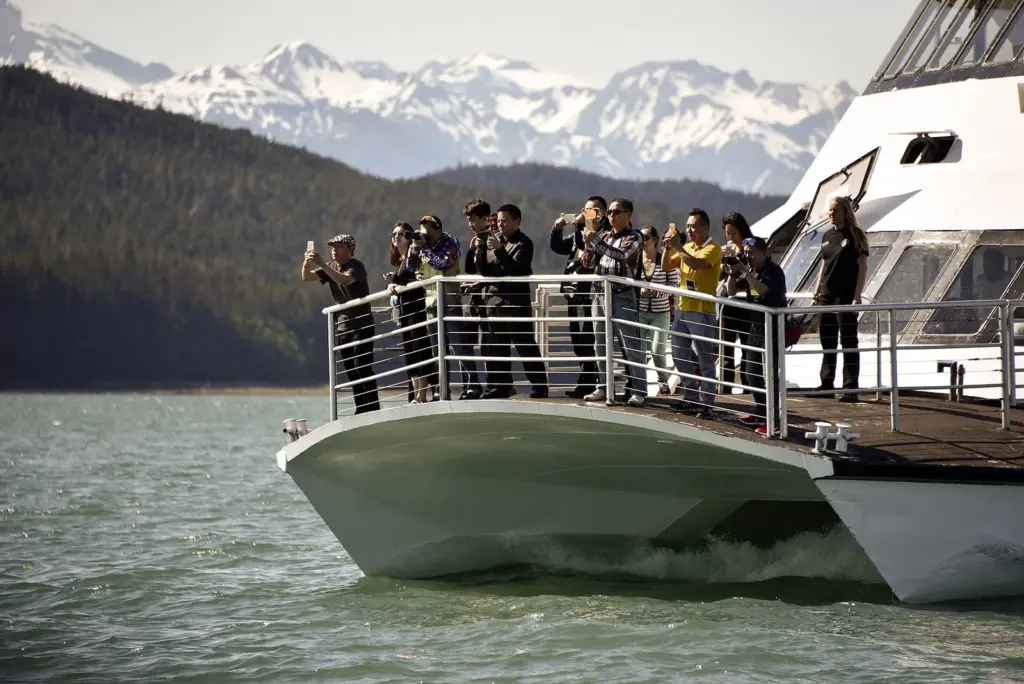
- Whale-watching passengers near Juneau: photo by Gillfoto, via Wikimedia Commons (CC BY-SA 4.0)