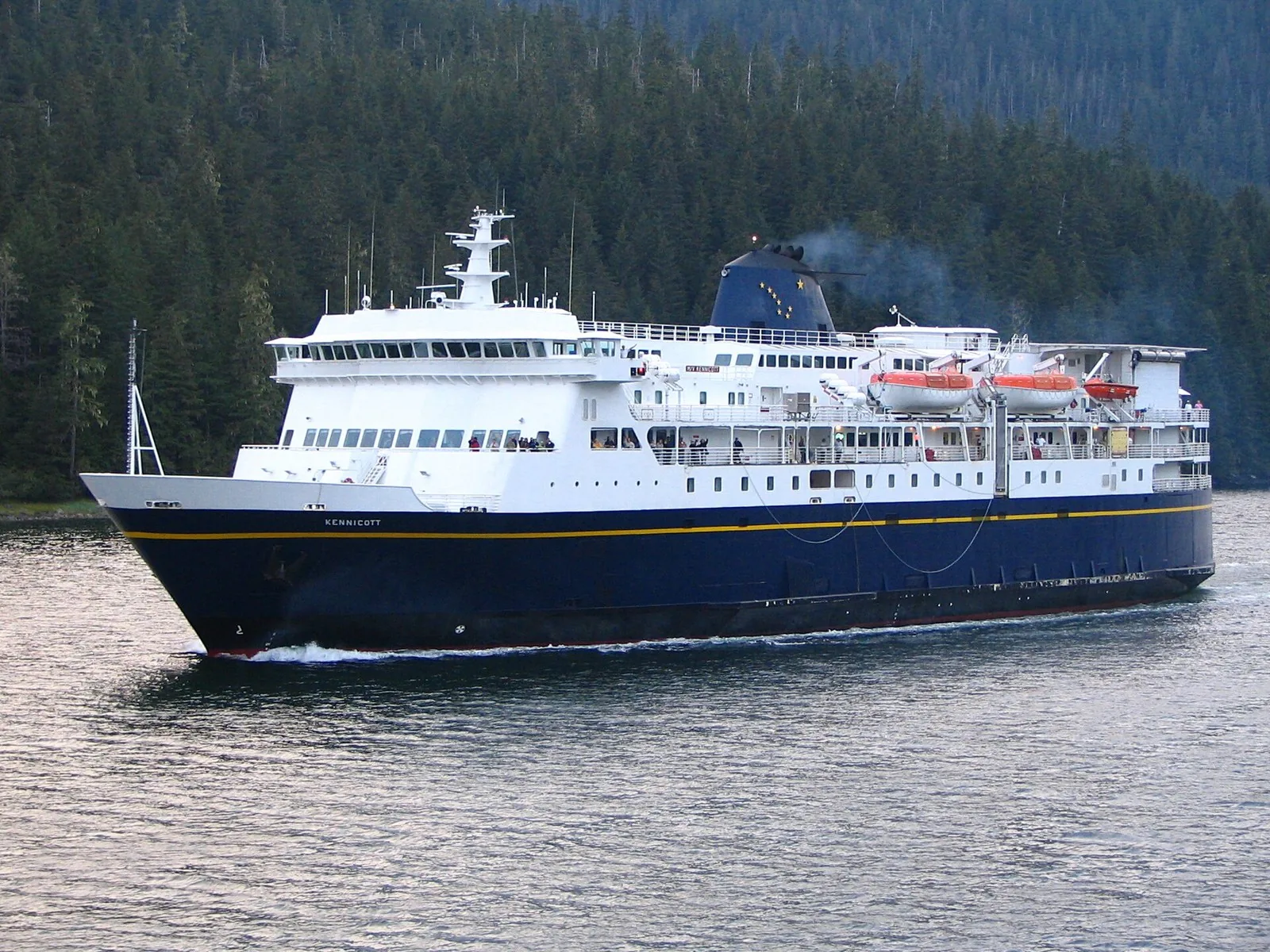
The Alaska Marine Highway is Alaska’s state-run ferry system, and for the right traveler it’s one of the most rewarding ways to see the Inside Passage. Its ships carry passengers, cars, bikes and kayaks from Bellingham, Washington, up the coast to Ketchikan, Wrangell, Petersburg, Juneau, Haines, Skagway and Sitka, while smaller ferries reach towns most cruise passengers never see. It isn’t a cruise. Nobody plans your day, meals cost extra, and the schedule bends around weather, mechanical trouble and the state budget. What you get in return is the same scenery, a stay in every town for as long as the schedule allows, and the freedom to drive off the boat and keep going.
This page is for independent travelers weighing the ferry against a cruise: people with time, people driving to or from Alaska, and anyone who’d rather spend three nights in a town than the six hours a Carnival seven-night Seattle cruise gives Ketchikan. The caveat that matters: the system has been running a thin schedule, with ships out of service and routes suspended, so plan around the sailings that actually exist for your dates, not the ones you remember from an old guidebook. Last updated November 21, 2026. Every price, fee and schedule below is dated, and the sources are listed at the end.
If you like the idea of a smaller, slower Alaska but want someone else to handle the planning, our guide to small ship Alaska cruises covers the expedition lines. This page is about the public ferry, the do-it-yourself version.
Ferry or Cruise? The Short Version
| What you’re comparing | Alaska state ferry | Big-ship cruise |
|---|---|---|
| Who runs it | The State of Alaska’s Department of Transportation and Public Facilities | Private cruise lines |
| Route | Bellingham to Ketchikan, Wrangell, Petersburg, Juneau, Haines, Skagway and Sitka, plus smaller towns | Seattle or Vancouver round trips, or one-way Gulf of Alaska cruises |
| Where you sleep | A cabin if you book one, or a recliner lounge, a covered solarium or a small tent on the upper deck | A cabin, always included |
| Meals | Pay as you go; full-service dining rooms on two ships | Main dining room and buffet included |
| Time in town | As long as the schedule allows: you book each leg port to port | Hours, set by the ship |
| Vehicles | Cars, RVs, trailers, bikes, kayaks and canoes | None |
| Glaciers | Seen from a distance, if at all; the ferry runs port to port | Scenic cruising days at Glacier Bay, Hubbard Glacier or Endicott Arm, depending on the line |
| Reliability | Sailings can be altered or canceled by weather or mechanical problems | Port calls can change or be skipped for weather |
How the Alaska Marine Highway System Works in 2026-27
The ferry system belongs to the state’s Department of Transportation and Public Facilities, which said in August 2026 that it runs nine ferries serving 35 communities along 3,500 miles of coastline. Its headquarters is in Ketchikan. For Inside Passage travelers, three kinds of route matter:
- The mainline. The big ferries run Bellingham, Ketchikan, Wrangell, Petersburg, Juneau, Haines, Skagway and Sitka. This is the route that stands in for a cruise.
- Feeder routes from Juneau. Smaller ships run from Juneau to Angoon, Gustavus and Hoonah, Haines, Kake, Pelican, Tenakee and Skagway. Gustavus is the gateway town for Glacier Bay National Park.
- Shuttles. A short run links Ketchikan with Metlakatla, the Tsimshian community on Annette Island.
Beyond Southeast, the same system runs routes in Prince William Sound and Southwest Alaska including Kodiak, and in November 2026 it added extra Prince William Sound sailings on the Tustumena. None of that touches the Inside Passage, but it’s the same booking site and the same phone line.
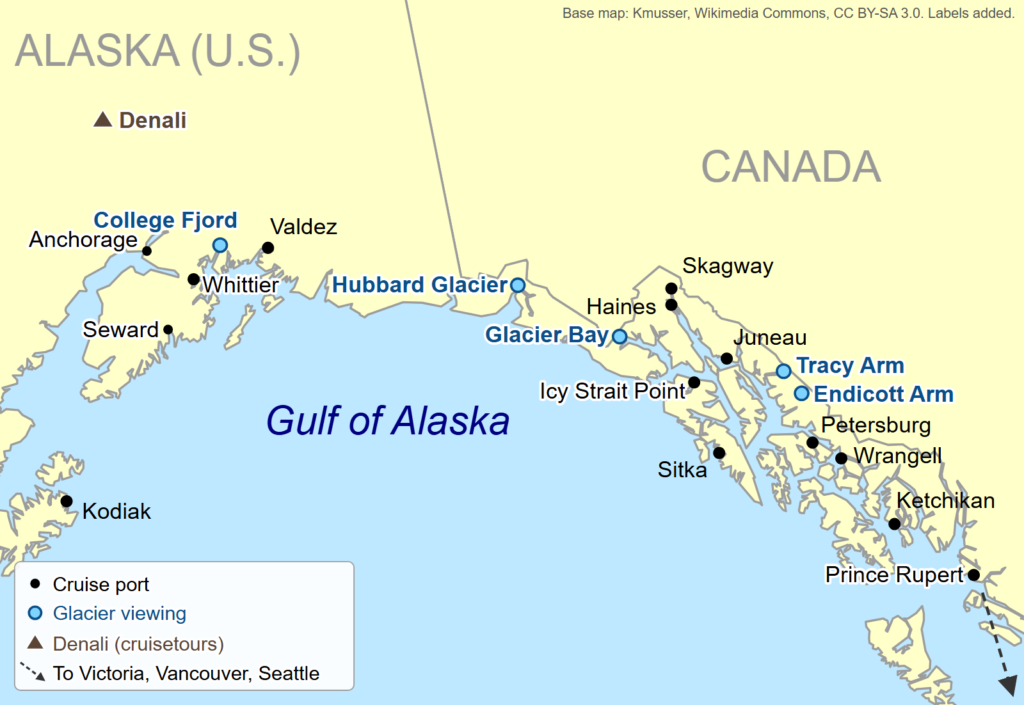
Here’s how long the legs take, by AMHS’s own route guide. These are running times, not door to door: port stops, tides and weather add to them, and in Sitka the departure time moves with the tides and current and is set by the captain.
| Leg | Scheduled running time |
|---|---|
| Bellingham to Ketchikan | 38 hours |
| Ketchikan to Wrangell | 6 hours |
| Wrangell to Petersburg | 3 hours 30 minutes |
| Petersburg to Juneau | 8 hours |
| Ketchikan to Juneau, start to finish | 20 hours |
| Juneau to Haines | 4 hours 30 minutes |
| Haines to Skagway | 1 hour |
| Juneau to Sitka | 9 hours 30 minutes |
What’s running, and what isn’t
The fleet is thinner than it used to be, and it pays to know which ships are actually sailing before you fall for a route:
- The Matanuska has been removed from revenue service.
- The Tazlina was listed as out of service for crew-quarters work in AMHS’s May 2026 fleet update.
- Prince Rupert, Yakutat and the cross-gulf route aren’t on the proposed winter 2026-27 schedule.
- The winter plan itself, AMHS says, depends on legislative funding.
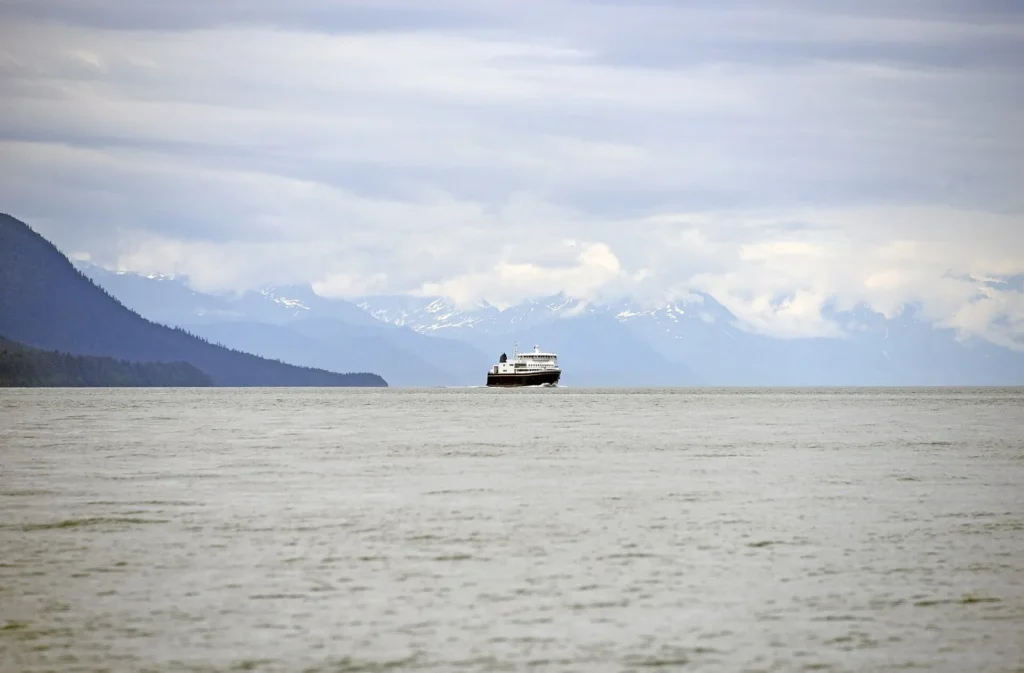
The Bellingham Ferry: 38 Hours to Ketchikan
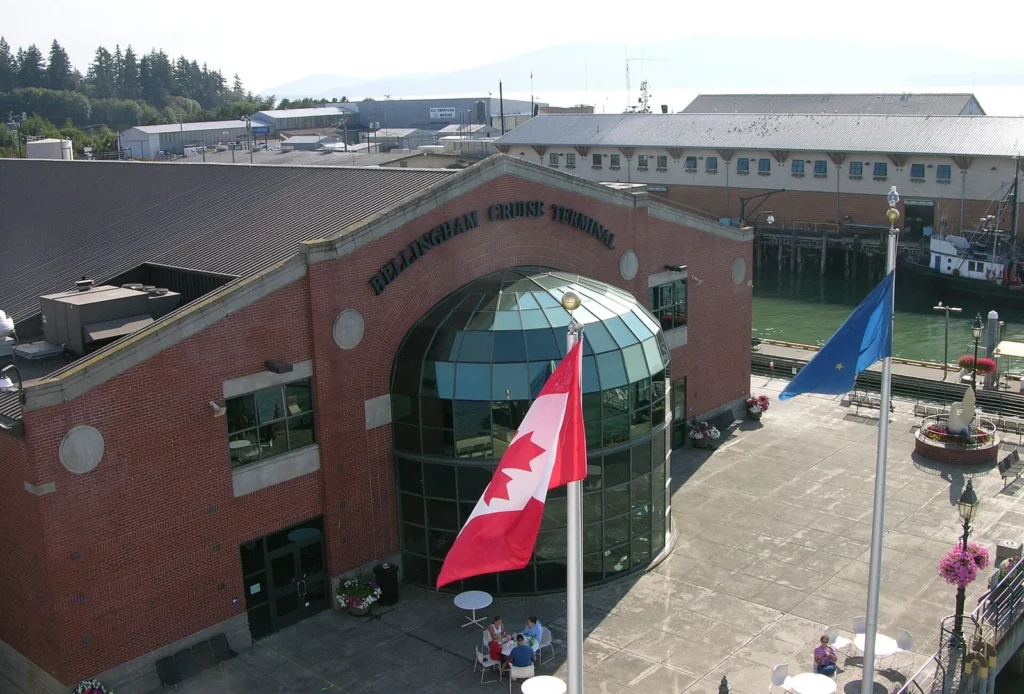
The southern end of the mainline is the Bellingham Cruise Terminal in Washington, about 90 miles north of Seattle. From there it’s 38 hours of sailing up the British Columbia coast to Ketchikan, the first Alaska stop, and another 20 or so on to Juneau. That’s the trip’s great strength and its great test. You get the whole Inside Passage, not just the Alaska end of it, and you spend a long stretch of it on a working ship with no ports to break it up.
In winter 2026-27 the run is a weekly Friday departure. AMHS’s proposed winter deployment assigned the Columbia to the Friday Bellingham route from October 1 to November 24, 2026, then sends it for overhaul and moves the Kennicott onto the route from December 2 through April 30, 2027. That handover leaves a short gap in late November, and the whole plan is marked as dependent on legislative funding, so confirm every sailing on the live schedule.
Summer is when most travelers want to go, and it hasn’t been generous lately. For summer 2026, AMHS put just one mainline ship, the Columbia, on the weekly Bellingham run, with the Kennicott on standby, and cited budget limits, Alaska Public Media reported in February 2026. That summer’s schedule opened for booking the same month, so watch the AMHS schedules page for the summer 2027 sailings, and book the day they open if you need a cabin or space for a vehicle.
You don’t need a passport for this trip, even though the route runs along Canada’s coast. AMHS says passengers sailing directly between Bellingham and any Alaska port don’t need one; only passengers who get off in Canada do. Everyone 18 and over needs government photo ID to board. Walk-on passengers check in two hours before departure at Bellingham (and at Juneau), and vehicles booked on the Bellingham run check in three hours ahead.
What the 38-hour run is like
Think of the Bellingham run as a two-night camping trip on a moving building. Walk-ons check in two hours before departure and pass through security, and anyone sleeping out should head for the recliner lounges or the solarium as soon as boarding opens, because the good corners go to the people who get there first. Drivers come through earlier, three hours ahead, and stow their cars below.
Once you’re underway, the day takes on a rhythm. If the Columbia is on the run, it has a full-service dining room; on other ships, food service is simpler, so the snacks in your bag earn their keep. Showers are on board, there’s no housekeeping, and the Wi-Fi, where the pilot service reaches, is good for a message home and not much more. Most people end up doing what the ship invites: reading, napping, talking to the Alaskans going home, and walking out on deck every time the channel narrows or something surfaces.
The first Alaska landfall is Ketchikan, 38 hours after Bellingham by AMHS’s running time. If you’re in a hurry, stay on. If you’re not, this is the moment the ferry starts to make sense: get off, take a room for two nights, and pick up the next sailing north.
Prince Rupert and the Canadian Connection
The Alaska ferry used to call at Prince Rupert, British Columbia, which gave Canadians and road-trippers a shorter way onto the system. It isn’t calling now. AMHS’s route guide says the proposed winter 2026-27 schedule doesn’t include Prince Rupert, Yakutat or the cross-gulf route.
When AMHS took Prince Rupert and cross-gulf sailings off sale for its 2025 schedule, it pointed to required generator upgrades to meet emission standards for marine vessels, work done while its certified ocean-class vessel was in the shipyard, and called the move temporary. Until Prince Rupert reappears on the schedule, Bellingham is the only southern gateway to the mainline.
Canadians can still reach Prince Rupert by road, or on BC Ferries’ Inside Passage route from Port Hardy on Vancouver Island; check BC Ferries’ own schedule for its 2027 sailings. From Prince Rupert, though, there’s no Alaska ferry onward on the current schedule, so the practical options are to drive north through British Columbia and the Yukon and board in Haines or Skagway, or to start in Bellingham.
Alaska Marine Highway vs a Cruise: What Really Changes
Price: you build it leg by leg
A cruise fare bundles your cabin, meals and transportation into one price per person. The ferry splits everything apart. You pay a passenger fare for each leg you sail, and a cabin and a vehicle are priced on top if you want them. AMHS quotes fares through the Sailing Search tool on its booking site, for your exact route and date, so run your own trip through it before you compare anything. On board, meals are pay as you go, cabin linens cost a small fee, and AMHS accepts only U.S. currency.
For scale on the cruise side, a seven-night Carnival round trip from Seattle in May 2027 started at $574 per person in an inside cabin when it was listed on November 20, 2026, before taxes and fees, with meals included. Whether the ferry comes out cheaper depends on your choices: skipping the cabin, carrying your own food and bringing a car you’d have to move north anyway all tilt the math toward the ferry. Where the ferry wins without question is time ashore.
Cabins or the deck
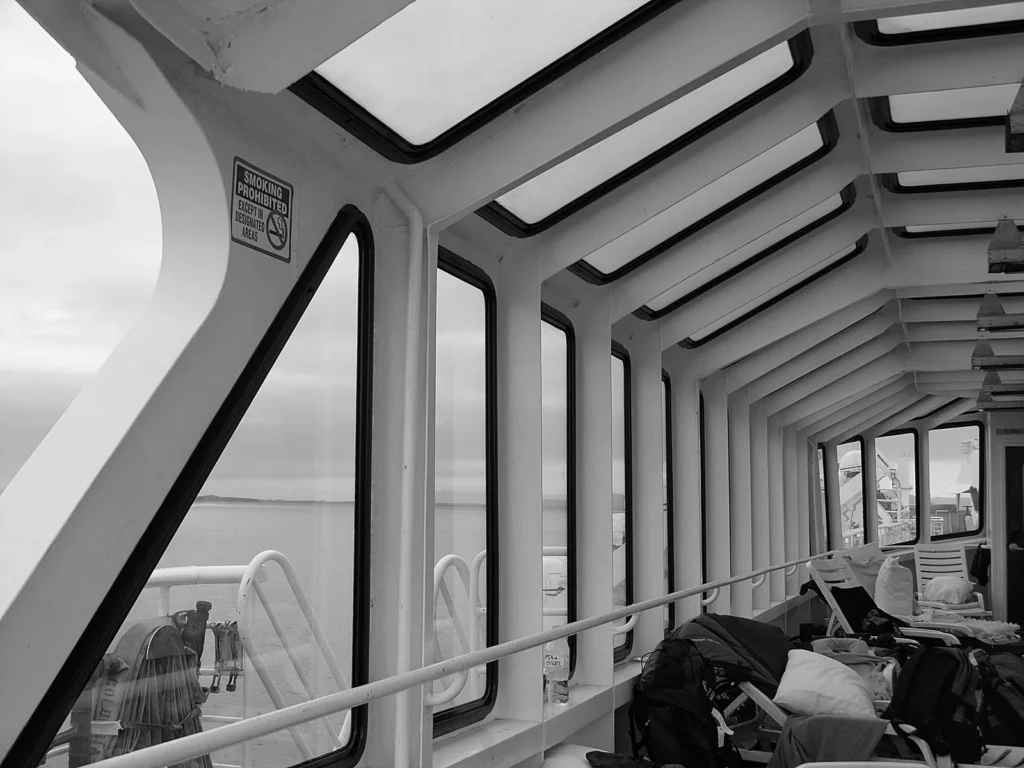
The classic ferry experience is sleeping out. Passengers without a cabin use the recliner lounges, which double as sleeping areas with room to roll out a sleeping bag, or the covered solariums on the upper decks. Small tents are allowed on the upper decks too, and the ferry system’s own advice to campers is to bring duct tape, because the wind across an open deck at ferry speed will try to take your tent to Canada.
Cabins are the comfortable option, and they’re limited, so book early if you want one. Showers are available on every ship except the small Lituya, there’s no cabin housekeeping, and linens, pillows and blankets come from the purser for a small fee.
Verdict: on a long leg like Bellingham to Ketchikan, a cabin buys real sleep. On short daytime hops, the lounges and the deck are all you need.
Food, Wi-Fi and life on board
Every ship except the Lituya has food service, and the Columbia and Tustumena have full-service dining rooms. Nothing is included in your fare, so pack snacks and a refillable bottle for the long legs. The ferry system offers complimentary satellite Wi-Fi on select ships as a pilot service, with the bandwidth shared by everyone on board, so it’s fine for messages and slow for anything else.
Don’t expect a cruise-style entertainment program. The entertainment is out the window: forested islands, fishing boats, the odd whale, and small towns sliding past at the pace of a working ship. Some people find that dull for about an hour, then can’t stop looking.
Reliability: the honest part
This is where the ferry asks the most of you. AMHS says a reservation guarantees space and service unless sailings are altered or canceled by weather or mechanical issues, and with ships already pulled from service, there isn’t much slack in the fleet when one breaks down. So build slack into your own plans. Don’t book a nonrefundable flight home for the day the ferry is due, keep a spare day at each end of the trip, and check AMHS’s service notices before you leave home and again before each leg.
Verdict: the ferry is a wonderful trip and an unreliable connection. Treat it as the trip, not as a way to catch something else.
Stopovers: Build Your Own Inside Passage Itinerary
This is the ferry’s superpower. A cruise gives you a fixed number of hours in each port. On the ferry, you get off wherever you like and stay as long as the schedule allows; to stay over, you simply book the trip port to port, one leg at a time. Our guide to Alaska cruise ports covers the towns the ferry shares with the big ships, and the feeder routes add the ones they skip.
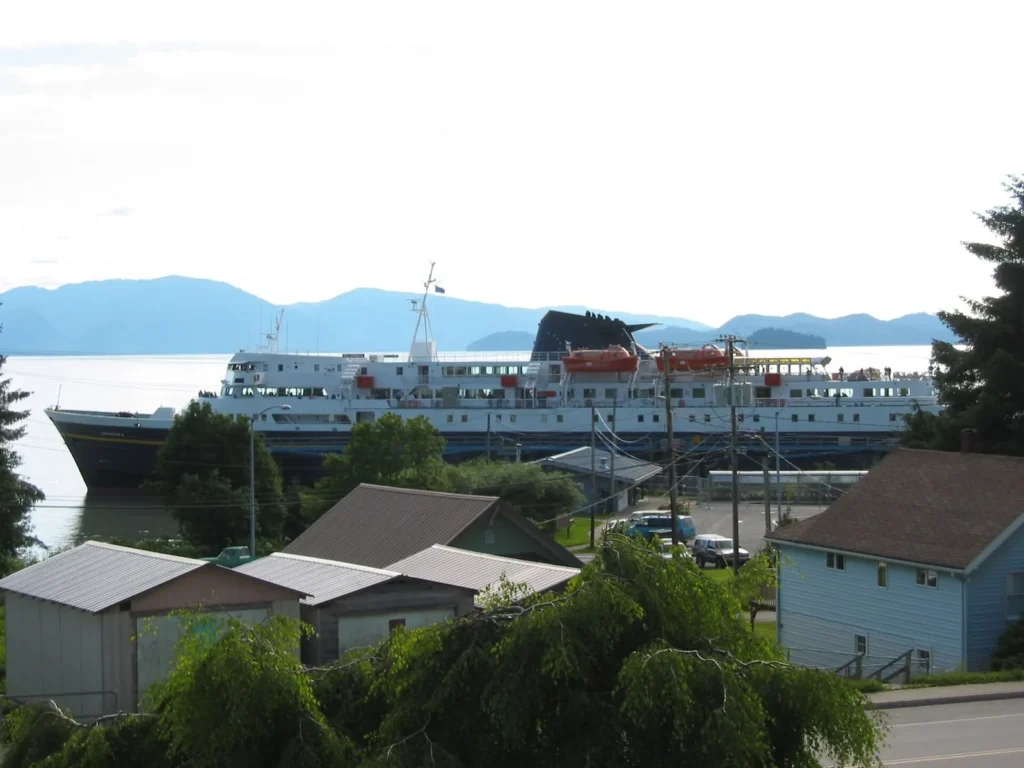
A northbound trip from Bellingham might look like this, using AMHS’s running times:
| Stop | Sailing time to get there | Why get off |
|---|---|---|
| Ketchikan | 38 hours from Bellingham | The first Alaska town: Creek Street, totem parks and salmon in the creek from July to October |
| Wrangell | 6 hours from Ketchikan | A small fishing town near the mouth of the Stikine River |
| Petersburg | 3 hours 30 minutes from Wrangell | A fishing town with Norwegian roots |
| Juneau | 8 hours from Petersburg | The capital: whales, Mendenhall Glacier and the feeder ferries |
| Haines | 4 hours 30 minutes from Juneau | The Chilkat Valley and its bald eagle preserve, and the road north |
| Skagway | 1 hour from Haines | Gold-rush history, the White Pass railway and another road north |
| Sitka (side trip) | 9 hours 30 minutes from Juneau | Russian and Tlingit history; departures move with the tides |
The catch is frequency. The mainline runs weekly from Bellingham, and smaller towns may see a ferry only on certain days of the week, so a one-night stopover can easily turn into three or four nights if the next ship isn’t due. Lay the schedule out for your dates before you book a single room ashore.
For Glacier Bay, the ferry gets you to Gustavus, the park’s gateway town, on the LeConte or the Hubbard from Juneau, according to AMHS’s fleet page. Seeing the glaciers themselves means booking a separate tour once you’re there.
Three Ways to Use the Ferry
The full mainline, Bellingham to Skagway
The purist’s trip. Board in Bellingham, ride 38 hours to Ketchikan and then work north through Wrangell, Petersburg and Juneau to Haines and Skagway, stopping wherever the schedule lets you. With a weekly mainline and stopovers of two or three nights, two to three weeks is a sensible length. At the far end, fly home from Juneau or keep going by road from Haines or Skagway.
The ferry-and-road loop
The road-tripper’s trip. Put the car on the ferry in Bellingham, drive off in Haines or Skagway, and take the Haines Highway or the Klondike Highway into Canada and on to the Alaska Highway. From there you can head into Interior Alaska and later drive south through the Yukon and British Columbia, or reverse the whole thing and finish with the ferry. Everyone in the car needs a passport, and the loop takes weeks, not days, but it’s the one trip that shows you both the coast and the interior from behind your own wheel.
Short hops from Juneau
The sampler, for travelers who fly into Juneau and want a taste of ferry travel without the long haul. Haines is 4 hours 30 minutes away by AMHS’s running time and Skagway an hour beyond it, Sitka is 9 hours 30 minutes from Juneau, and the feeder routes reach Gustavus, Hoonah and the small villages. A few days in Haines or Skagway, with the privately run fast ferry linking the two, makes an easy add-on to a Juneau stay, and you can fly back rather than sail.
Verdict: for a first ferry trip, the Juneau sampler is the low-risk choice. If it hooks you, the full mainline is the trip people talk about for years.
Bringing a Car, RV, Bike or Kayak
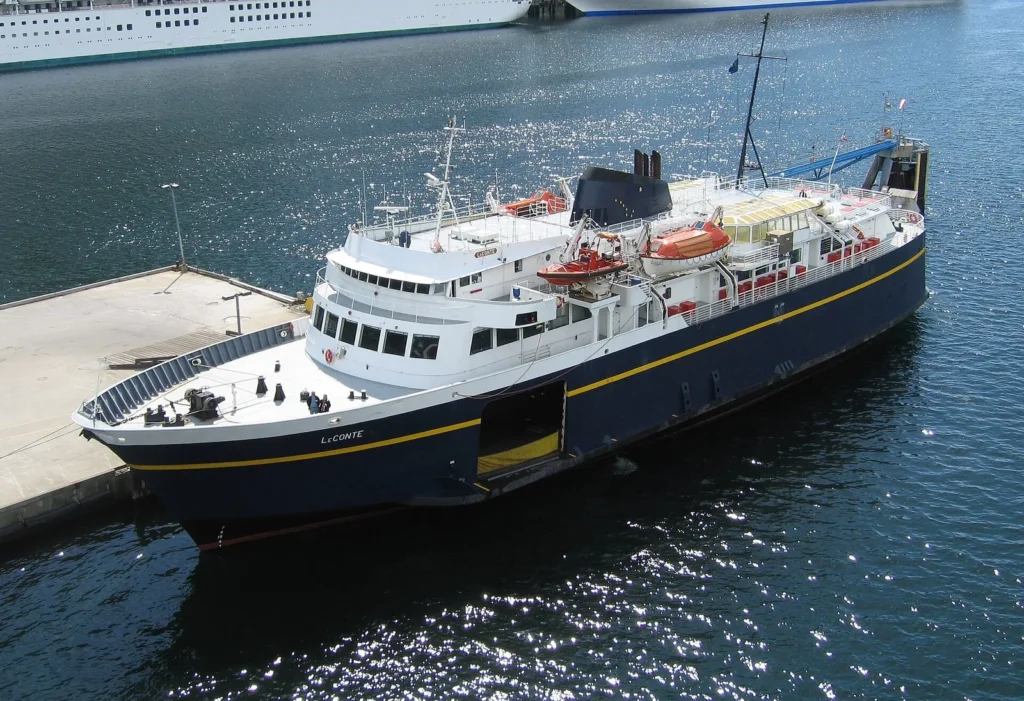
The ferry is the only way to drive into most of Southeast Alaska, because most of its towns, Juneau included, have no road connection to the rest of North America. Vehicles are quoted in the same Sailing Search, and advance reservations are what guarantee you a spot. On the Bellingham run, vehicles must check in three hours before departure, and one that misses check-in can lose its space to a standby passenger. The ferries also take commercial vans and trailers up to 48 feet, plus kayaks and canoes; small inflatable boats qualify if they weigh under 300 pounds and are no more than 18 feet long.
Pets travel on the car deck only, in a carrier or in your vehicle. On a 38-hour leg that’s a real consideration, so talk to your vet and plan the trip around your animal, not the other way round.
In Southeast Alaska, two ferry towns connect to the highway system: Haines, by the Haines Highway, and Skagway, by the Klondike Highway. Both roads cross into Canada on the way to the Alaska Highway, so everyone in the car needs a passport, and you’ll clear Canadian customs going north and U.S. customs coming back into Alaska. That makes the classic one-way-by-ferry, one-way-by-road trip possible: sail north from Bellingham with your car, drive off in Haines or Skagway and carry on into the Interior, or do it in reverse.
One more Lynn Canal option is private: the Haines-Skagway Fast Ferry, which is passenger only and takes about 45 minutes. Its 2026 fares were $65 one way for adults and $112 round trip, so check its own site for the 2027 season before you plan around it.
Who Should Take the Ferry, and Who Shouldn’t
Choose the Alaska Marine Highway if:
- you have two weeks or more and dates that can bend;
- you’re driving to or from Alaska, or moving there with a car full of belongings;
- you’d rather see small towns at their own pace than big-ship ports on a busy day;
- you travel light and don’t mind sleeping in a lounge or a tent;
- you’re bringing a bike or a kayak and want to paddle or ride between towns.
Choose a cruise if:
- you have one week and fixed dates;
- you want tidewater glaciers up close, at Glacier Bay, Hubbard Glacier or Endicott Arm, since the ferry runs port to port;
- you want your cabin, meals and transportation in one price;
- you need a schedule you can count on to the hour.
If a cruise sounds like the better fit, our guide to choosing an Alaska cruise itinerary compares the routes. There’s also a middle ground. Small expedition ships give you the ferry’s scale with a cruise’s comfort: compare an Alaska expedition cruise, a National Geographic Alaska cruise with Lindblad, or the small-ship voyages of UnCruise Alaska, and American Cruise Lines Alaska sailings are another option. Our small ship vs big ship Alaska cruise comparison lays out the trade-offs. With a bigger budget, look at luxury Alaska cruises, from Silversea Alaska and Seabourn Alaska voyages to a Regent Alaska cruise, an Oceania Alaska cruise or Windstar Alaska sailings, or charter your own boat with an Alaska yacht charter. Couples who want quiet can look at an adults only Alaska cruise.
How to Book the Alaska Marine Highway Ferry
- Price your route first. Run each leg through Sailing Search on AMHS’s booking site, or call reservations at 1-800-642-0066. Online booking closes four hours before sailing at staffed terminals, and 15 minutes before at unstaffed ports.
- Book cabins and vehicles as soon as the schedule opens. Deck space is the fallback; a cabin or a car-deck spot may not be.
- Check in on time. Walk-ons check in two hours ahead at Bellingham and Juneau and one hour ahead elsewhere; vehicles check in three hours ahead on the Bellingham run.
- Bring the paperwork. Government photo ID for everyone 18 and over, passports if you’ll get off in Canada or drive through it, and U.S. cash or cards, since the ferry takes only U.S. currency.
- Pack for a working ship. Walk-ons can hand-carry up to 100 pounds of baggage. Bring food for the long legs, warm layers, earplugs, a sleeping bag if you’re not in a cabin, and duct tape if you’re bringing a tent.
- Watch the service notices. Check them when you book, the week before you travel and the morning of each leg.
For more ways to see Alaska from a smaller boat, with someone else doing the planning, see our guide to small ships and expedition cruising in Alaska.
Alaska Marine Highway FAQ
How long is the Alaska ferry from Bellingham?
AMHS’s route guide puts the sailing from Bellingham to Ketchikan, the first Alaska stop, at 38 hours, and Ketchikan to Juneau at another 20 hours, before time in port. In winter 2026-27 the ferry leaves Bellingham on Fridays. Check the AMHS schedule for your season, because the deployment changes and depends on state funding.
Do you need a passport for the Alaska Marine Highway ferry?
Not if you sail directly between Bellingham and an Alaska port. AMHS says only passengers who get off in Canada need a passport. Everyone 18 and over needs government photo ID. If you plan to drive from Haines or Skagway through Canada, everyone in the car needs a passport for the road trip.
Can you sleep on the deck of the Alaska ferry?
Yes. Passengers without a cabin can sleep in the recliner lounges or the covered solariums on the upper decks, and small tents are allowed on the upper decks. The ferry system tells campers to bring duct tape to hold tents down. Cabin linens, pillows and blankets cost a small fee.
Is the Alaska Marine Highway cheaper than a cruise?
Sometimes. A cruise fare includes your cabin and meals, while the ferry charges each leg separately and adds cabins, vehicles and food on top. Price your exact route in AMHS’s Sailing Search, which quotes fares for your dates. Skipping the cabin and bringing your own food make the ferry easier on the budget.
Does the Alaska ferry still go to Prince Rupert?
Not on the current schedule. AMHS’s route guide says the proposed winter 2026-27 schedule has no Prince Rupert, Yakutat or cross-gulf sailings. When it pulled those routes for 2025, AMHS cited required generator upgrades on its certified ocean-class vessel. Check the AMHS schedules page for any return.
Can you take a car on the Alaska Marine Highway?
Yes, and for most of Southeast Alaska it’s the only way to bring one. Book vehicle space early, since reservations guarantee your spot, and check in three hours before departure on the Bellingham run. Haines and Skagway connect to the highway system through Canada, so drivers can take the ferry one way and the road the other.
What is the best Alaska Marine Highway trip for a first-timer?
A short sampler from Juneau. Haines is 4 hours 30 minutes away by AMHS’s running time and Skagway an hour beyond it, so you can spend a few days in each and fly back, without committing to the 38-hour run from Bellingham. If you love it, the full mainline with stopovers is the next trip.
Is there Wi-Fi on the Alaska ferry?
On some ships. AMHS offers complimentary satellite Wi-Fi on select vessels as a pilot service, and the bandwidth is shared by everyone on board. It’s fine for messages and email, slow for video. Download maps, books and entertainment before you sail, especially for the 38-hour run from Bellingham.
Related Alaska Cruise Guides
- Small Ship Alaska Cruises: Expedition, Luxury and Adventure Lines Compared
- Alaska Cruise Itineraries: Every Route, Port Combination and Length Compared
- Alaska Cruise Ports: Every Port of Call Ranked, Mapped and Explained
Sources and How We Checked
We checked the prices, rules, schedules and ship deployments in this guide against the sources below on November 20, 2026, and we log each one in our research database with the date it was checked. Cruise lines change ships, fares and fees every season, so confirm anything that affects your booking with the line or the agency concerned. Alaska Cruise Guide (AlaskaCruise.org) is an independent publication. It is not affiliated with any cruise line, port, tour operator or tourism office, and no one paid to be included.
- Alaska Department of Fish and Game: Ketchikan salmon viewing
- Alaska DOT&PF: Alaska Marine Highway System
- Alaska DOT&PF: Alaska Marine Highway System
- Alaska DOT&PF: Alaska Marine Highway System
- Alaska DOT&PF: Alaska Marine Highway System
- Alaska DOT&PF: Alaska Marine Highway System
- Alaska DOT&PF: Alaska Marine Highway System
- Alaska DOT&PF: Alaska Marine Highway System
- Alaska DOT&PF: Alaska Marine Highway System
- Alaska Public Media: Alaska Marine Highway System
- Alaska State Parks: Chilkat Bald Eagle Preserve
- carnival.com: Carnival Cruise Line
- hainesskagwayfastferry.com: Haines Skagway Fast Ferry
Photo Credits
- The Alaska ferry Kennicott: photo by Photo (c)2006 Derek Ramsey (Ram-Man), via Wikimedia Commons (GFDL 1.2)
- Alaska coast and ports map: map by Kmusser, via Wikimedia Commons (CC BY-SA 3.0); ferry routes removed; cruise ports, glacier-viewing areas and Denali added by Alaska Cruise Guide
- The ferry Tazlina in Favorite Channel: photo by Gillfoto, via Wikimedia Commons (CC BY-SA 4.0)
- Bellingham Cruise Terminal: photo by Photo (c)2006 Derek Ramsey (Ram-Man), via Wikimedia Commons (CC BY-SA 2.5)
- Solarium on the ferry Columbia: photo by Photo (c)2006 Derek Ramsey (Ram-Man), via Wikimedia Commons (CC BY-SA 2.5)
- The Matanuska leaving Wrangell: photo by James Crippen, via Wikimedia Commons (Public domain)
- The ferry LeConte at Skagway: photo by JWebber, via Wikimedia Commons (Public domain)